
New Delhi:
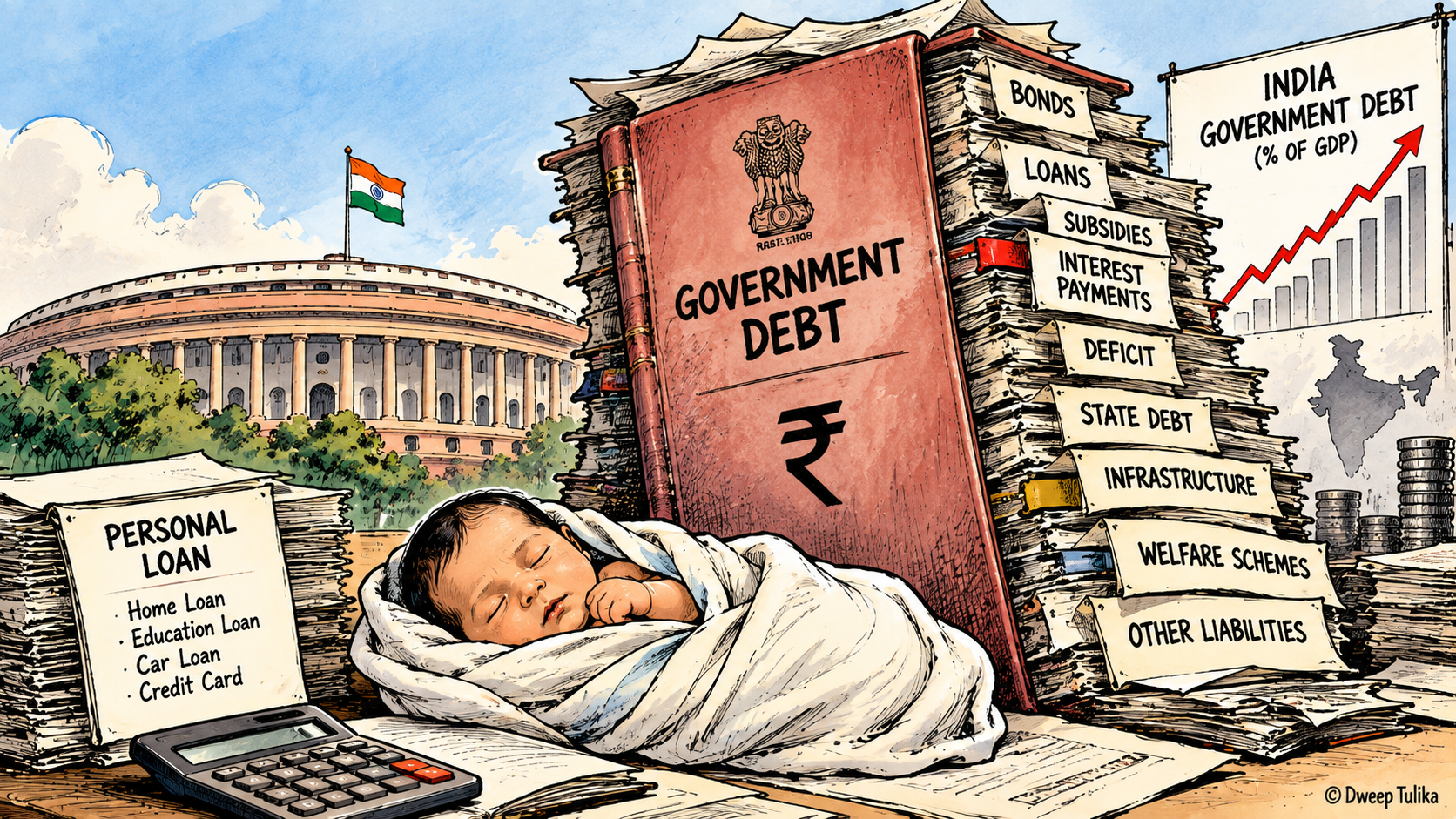
The statement that “every child born in India is born with ₹90,000 of debt” is often used to explain India's public-debt burden. But the figure needs context.
According to the International Monetary Fund's 2025 Article IV consultation, India's general government debt is projected at 81.1% of GDP for 2025–26. The IMF definition used in the report combines the liabilities of the central and state governments and sovereign external debt. IMF eLibrary
In simple terms, the government's outstanding debt and liabilities are equivalent to roughly four-fifths of one year's economic output.
What does 81.1% actually mean?
It does not mean that every Indian citizen has a personal loan of an equivalent amount.
Government debt is a liability of the public sector. Governments borrow through various instruments and use revenues, expenditure management and economic growth to service and repay that debt.
The IMF's measure is also different from simply adding up loans taken by individual citizens. The report specifically says its general-government measure includes the combined domestic liabilities of the Centre and states, along with sovereign external debt. IMF eLibrary
India’s debt has changed over time
The latest IMF series shows:
| Financial year | General government debt |
|---|---|
| 2021–22 | 83.5% of GDP |
| 2022–23 | 82.2% |
| 2023–24 | 80.7% |
| 2024–25 | 81.6% |
| 2025–26 | 81.1% |
| 2026–27* | 80.7% |
*IMF projection. IMF eLibrary
The earlier 2024 IMF Article IV report had estimated India's general government debt at 88.4% of GDP in 2020–21. That explains why the 88.4% figure appears in some discussions, but it should not be mixed into the newer IMF series without explaining the different report vintages. IMF
So, is ₹90,000 per Indian a real debt figure?
Not as a literal personal debt.
A per-person debt figure is a calculation obtained by dividing a particular definition of government debt by the population. The resulting number changes depending on:
- which year is used;
- whether Centre-only or general government debt is counted;
- the population estimate used;
- the exchange rate and accounting methodology; and
- which liabilities are included.
Therefore, saying “every child is born owing ₹90,000” can be useful as a simplified illustration of the scale of public debt, but it should not be presented as an actual debt attached to every newborn.
The bigger question is fiscal space
The more meaningful question is not whether a newborn receives a debt bill.
It is how much the government borrows, what it borrows for, how much it pays in interest, and whether economic growth and government revenues remain sufficient to manage those obligations.
The IMF's 2025 report projects India's general government debt to gradually decline from 81.1% of GDP in 2025–26 to 76.0% by 2031–32 under its baseline projection. These are projections, not guarantees. IMF eLibrary
That leaves an important public-policy question:
When governments borrow today, what economic and public benefits are created for tomorrow — and what portion of future public revenue will be required to service that borrowing?
That is a more meaningful debate than simply asking whether a newborn has been handed a ₹90,000 loan.
Sources: International Monetary Fund, India: 2025 Article IV Consultation; IMF India: 2024 Article IV Consultation.