
On Bhagat Singh’s birth anniversary, Dweep Tulika looks back at the Hindustan Socialist Republican Association (HSRA), a revolutionary organisation that formed part of India’s wider struggle against British colonial rule. Its members sought not only political independence but also a society shaped by socialist ideas.
The Hindustan Republican Association was reorganised as the HSRA at a meeting in Delhi’s Feroz Shah Kotla on 8–9 September 1928. Among the revolutionaries associated with the organisation were Bhagat Singh, Chandrashekhar Azad, Sukhdev Thapar and Bhagwati Charan Vohra. The change in the organisation’s name reflected the growing emphasis on socialism as a goal alongside independence.
How did the HSRA contribute to the freedom struggle?
The HSRA’s activities included revolutionary actions, political statements and efforts to draw public attention to colonial rule. Two events became particularly prominent in its history: the killing of British police officer J. P. Saunders in Lahore in December 1928, and the bombing of the Central Legislative Assembly in Delhi by Bhagat Singh and Batukeshwar Dutt on 8 April 1929. The Saunders killing followed the police lathi-charge during protests against the Simon Commission, in which Lala Lajpat Rai was injured and later died.
The Assembly action was planned as a protest against legislation including the Public Safety and Trade Disputes bills. Singh and Dutt threw bombs and distributed leaflets explaining their action. They did not flee the scene and were arrested. Their trial and statements gave them a public platform to present their political ideas.
The HSRA was one strand within a much broader independence movement that included mass campaigns, constitutional politics, labour organising and other forms of resistance. Its members’ actions and ideas brought debates about socialism, workers’ rights and economic equality into discussions about the future of India.
The newspaper and the power of the pen
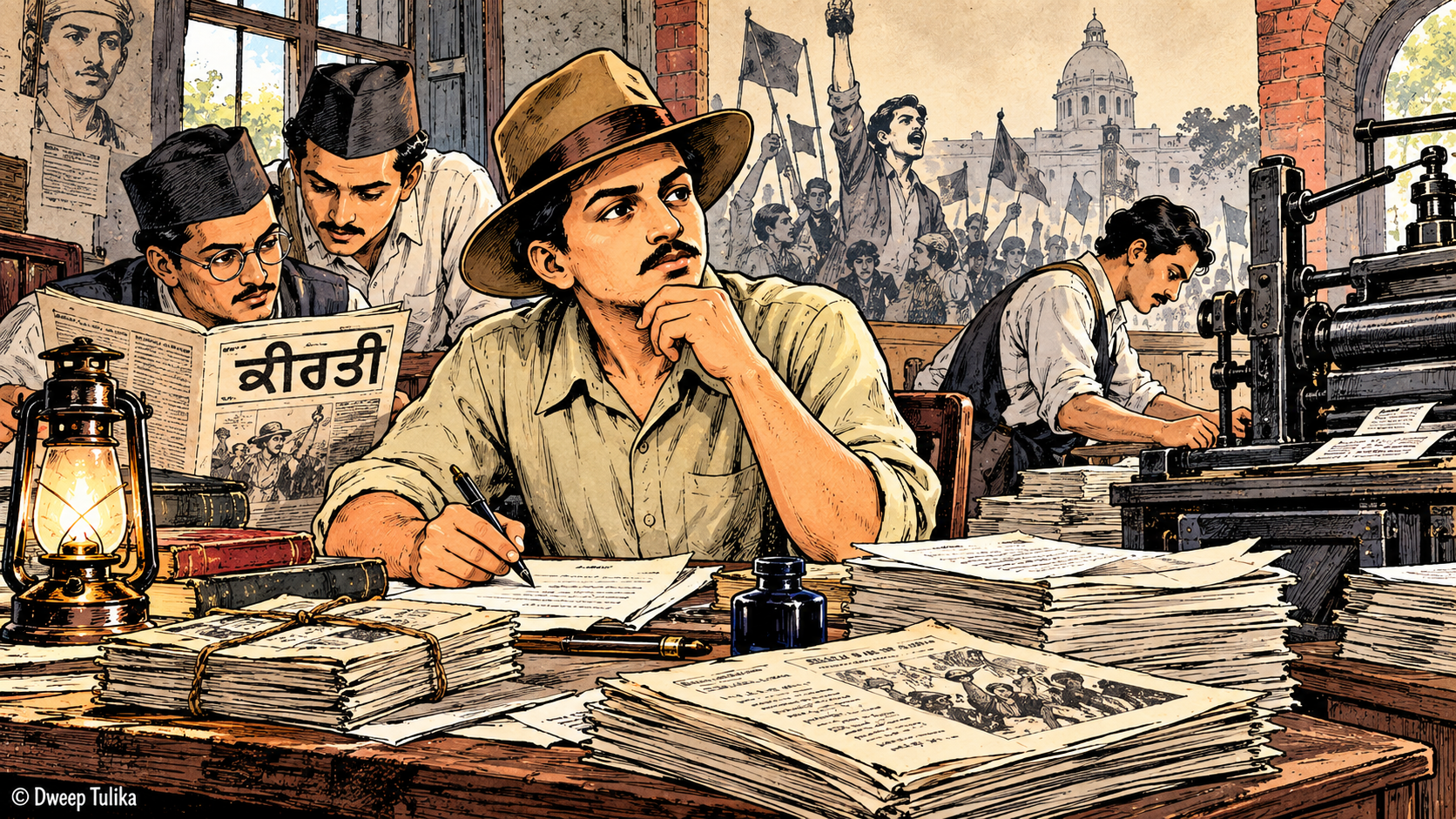
Bhagat Singh’s contribution to the freedom struggle also extended to writing and political communication. The Government of India’s Dictionary of Martyrs records that he worked for a time on the editorial staff of Kirti, a socialist journal. The publication provided a platform for political discussion, but it should not be described as the HSRA’s official newspaper.
Alongside articles and other writing, the revolutionaries used pamphlets, leaflets and public statements to explain their objectives and reach readers beyond their immediate circles. The leaflet distributed during the Assembly bombing, for example, set out the reasons the revolutionaries gave for their action.
The history of the HSRA shows that India’s freedom struggle involved different methods and political visions. Its legacy includes both the dramatic actions of its members and the ideas they brought into public debate.
Remembering Bhagat Singh: a revolutionary whose words and actions remain part of India’s history.