
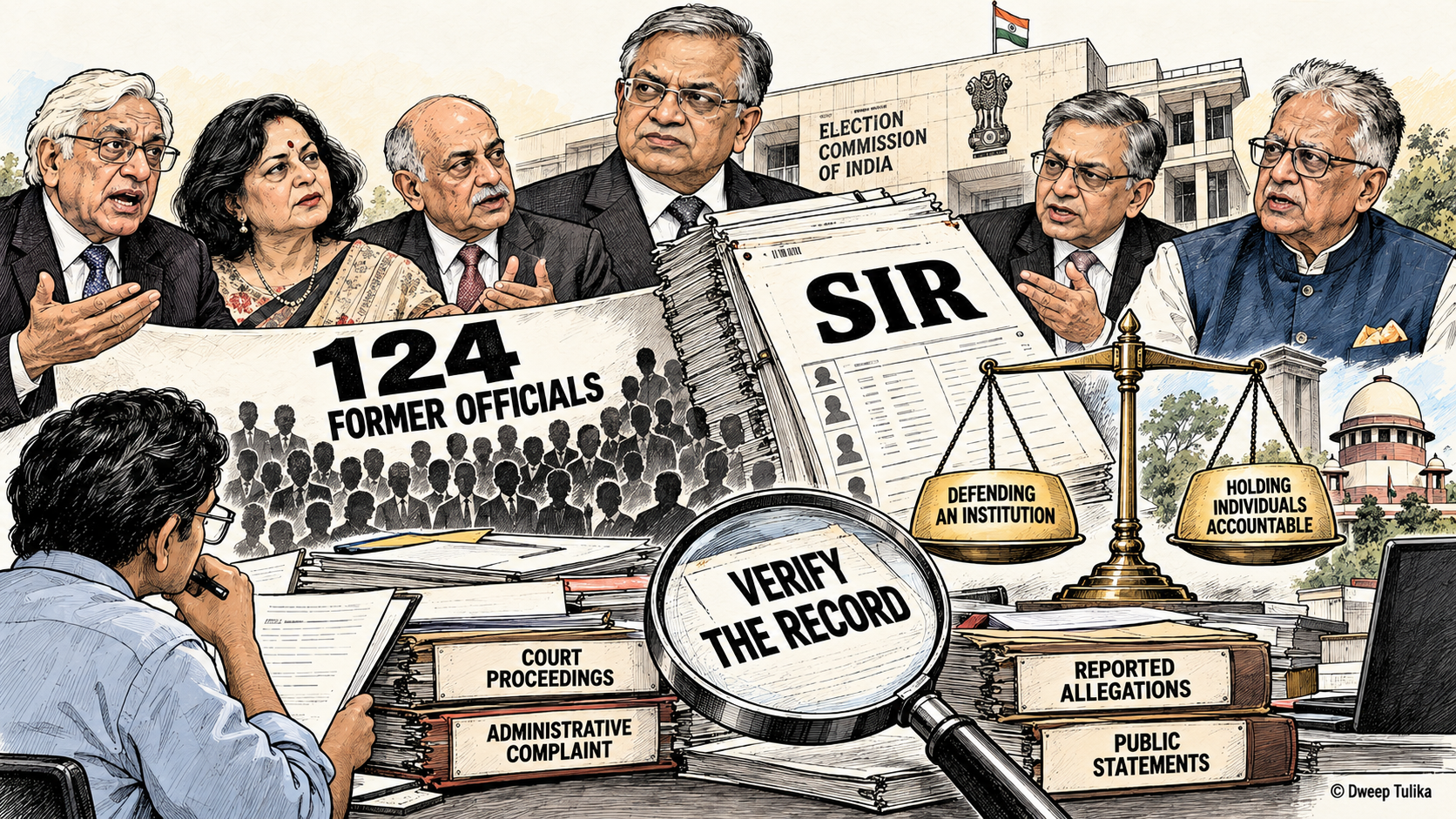
The open letter, issued on October 10, came amid protests and political disputes over electoral-roll revision. The signatories defended safeguards in India’s electoral system, including polling agents, the sealing and storage of electronic voting machines, and Voter Verifiable Paper Audit Trail (VVPAT) procedures. They also argued that allegations of rigging should not be accepted without evidence. <Cite refs={["turn186147search0","turn186147search4"]}/>
Among the signatories identified in media reports are former Foreign Secretary Kanwal Sibal, former ambassador Bhaswati Mukherjee, former IAS officers M. Madan Gopal and Navneet Sehgal, and former ambassador Deepak Vohra.
The public record concerning some of these individuals includes reported legal proceedings, administrative complaints and contested public statements. These matters differ substantially in their evidentiary status and must not be treated as proof of collective wrongdoing. Nor does a controversy involving a signatory, by itself, establish that the person’s arguments about electoral procedures are incorrect.
Deepak Vohra: Reported CBI prosecution sanction
One of the legal matters identified in the preliminary review concerns former Indian ambassador to Sudan Deepak Vohra.
In February 2022, The New Indian Express reported that the government had granted the Central Bureau of Investigation sanction to prosecute Vohra and former Under Secretary Ajoy Ganguly in connection with alleged financial irregularities involving Indian diplomatic missions.
The report said a special CBI court had rejected two closure reports submitted by the investigating agency. The court had observed that the material before it prima facie disclosed offences and indicated a possible conspiracy involving officials and another individual. The allegations concerned payments and documentation associated with the Indian consulate in Juba, South Sudan. The court’s observations concerning Vohra included a possible role as an abettor. <Cite refs={["turn186147search7"]}/>
Vohra told PTI that he was unaware of the matter, according to the report.
A prosecution sanction and preliminary judicial observations are not convictions. The final outcome of the proceedings was not established in the material reviewed for this article. Any account of the case should therefore distinguish the reported procedural history from a final determination of guilt.
Vohra also attracted public criticism following a lecture at Lady Shri Ram College in September 2025, according to media reports. The reported controversy concerned remarks about gender, marriage, religion and the Ram Temple. It was a dispute over public statements and their reception, not itself a finding of criminal misconduct.
M. Madan Gopal: Complaint concerning Karnataka forest land
Former IAS officer M. Madan Gopal was named in complaints concerning the de-notification of forest land in Karnataka.
According to The Indian Express, social activist Gireesh Achar filed complaints in September 2022 with the Ministry of Environment, Forest and Climate Change and the Karnataka Lokayukta seeking an inquiry into the de-notification of approximately 9,934 acres of forest land in Shivamogga district between 2015 and 2017. The complaint named Madan Gopal and former IAS officer T. M. Vijaya Bhaskar and referred to 56 de-notification orders.
The complainant argued that the orders had been issued without the required Union government approval. The complaint also referred to a Karnataka High Court order dated March 4, 2021, which quashed one de-notification order issued on February 23, 2017.
These reported developments raise questions about the administrative decisions and the legal safeguards governing forest land. However, a complaint and a court order concerning a particular decision do not, on their own, establish personal criminal liability for every official named in a complaint. The final outcome of an inquiry into Madan Gopal’s individual responsibility was not verified for this report.
Madan Gopal has also made public arguments concerning religious demographics and national security, according to media coverage. Any assessment of those claims should examine the original statements, the population data cited and the evidence used to support the conclusions.
A separate statement attributed to him describing the violence in Manipur as an ethnic conflict should not be quoted as a confirmed verbatim remark without checking the original recording or transcript.
Navneet Sehgal: Allegations reported from an Income Tax dossier
Former IAS officer Navneet Sehgal, who previously served as chairman of Prasar Bharati, was named in a Newslaundry investigation published on December 23, 2025.
The report examined a confidential 254-page Income Tax Department dossier concerning alleged kickbacks linked to government tenders and schemes in Uttar Pradesh during 2019–20 to 2021–22. It described alleged cash transfers, property trails and transactions involving contractors, companies and officials. The report said investigators had examined an alleged network through which at least ₹112 crore of public money was suspected to have been siphoned. It identified Sehgal as an alleged beneficiary. <Cite refs={["turn186147search5"]}/>
Sehgal denied the allegations. In a response published by Newslaundry, he said the matter had been examined by the Income Tax Department, that he had submitted explanations and supporting material, and that the matter had been finalised. He described the allegations as baseless. <Cite refs={["turn186147search6"]}/>
The reported dossier and Sehgal’s response are both relevant to an accurate account. The underlying departmental findings and any subsequent official action would need to be examined before drawing conclusions about the allegations. They cannot be presented as proven corruption merely because they appeared in an investigative report.
His inclusion among the 124 signatories does not establish that his position on the Election Commission is connected to the financial allegations.
Kanwal Sibal: Defence of the Adani Group against US action
Former Foreign Secretary Kanwal Sibal publicly criticised US action concerning the Adani Group in November 2024, arguing that it raised questions of Indian sovereignty and the exercise of American legal power.
Sibal questioned the jurisdictional basis of the US proceedings and argued that allegations of bribery should be addressed through appropriate legal channels in India. His comments concerned sovereignty, jurisdiction and the exercise of US enforcement powers.
Subsequent legal developments may be relevant to evaluating the context of his arguments, but they do not establish that Sibal knowingly defended unlawful conduct. His public position should be assessed against the precise statements he made and the legal facts available at the time.
A defence of a controversial company or criticism of foreign enforcement action is not, by itself, evidence of personal wrongdoing.
Bhaswati Mukherjee: Dispute over religious-freedom assessments
Former ambassador Bhaswati Mukherjee has publicly challenged assessments of religious freedom in India issued by the US Commission on International Religious Freedom (USCIRF).
In March 2026, Mukherjee and M. Madan Gopal were identified as coordinators of a collective statement by former judges, bureaucrats and military officers disputing USCIRF’s assessment. The statement challenged the report’s interpretation of conditions in India and questioned its methodology and context.
That disagreement is a matter of public debate. Establishing whether the criticism is factually justified requires a comparison of the collective statement, USCIRF’s underlying evidence and other reliable information on religious freedom.
A separate claim attributed to Mukherjee—that India’s electoral system is the best in the world, including better than that of the United States—has not been verified against an original interview or speech in the material reviewed for this report. It should not be published as a confirmed quotation without a primary source.
Public statements and professional ethics: Verify the original record
K. Aravinda Rao, a former Director General of Police in Andhra Pradesh, is another signatory whose statements have been discussed in connection with the group.
A quotation circulating in online discussions attributes to Rao an admission that he had compromised his ethics under political pressure “many times”. A transcript of his 2012 interview, Open Heart With RK, examined during the preliminary review did not substantiate that exact exchange.
The transcript discusses political pressure and professional integrity, but that does not establish that the specific quotation is authentic. The original recording or a reliable transcript containing the exact words is required before it can be published as fact.
The distinction is fundamental to investigative reporting: a quotation that appears damaging cannot be treated as authentic simply because it is repeated.
The larger question: Accountability and institutional trust
The 124 former officials argue that allegations against electoral institutions should be supported by credible evidence. That principle applies equally when examining the public records of the people making the argument.
The matters identified in this review fall into different categories: a reported CBI prosecution sanction and preliminary court observations; an administrative complaint involving forest land; allegations in an investigative report based on a confidential tax dossier; and public controversies involving political or institutional statements.
They cannot be collapsed into a single allegation of wrongdoing. Each requires its own evidence, procedural context and response from the individuals concerned.
This preliminary review has not established that a majority of the 124 signatories are facing allegations, nor has it established that the group is collectively guilty of misconduct. Such a claim would require a complete, person-by-person review of the signatories’ records and the outcomes of any relevant proceedings.
The publication of the letter nevertheless provides an opportunity to examine the public record of those who signed it, particularly where they invoke their administrative experience to comment on institutions of national importance.
The central question is not whether former officials are entitled to defend the Election Commission. They are. It is whether public confidence in institutions is best served by applying the same standards of evidence, transparency and accountability to allegations against institutions and to claims about the people defending them.
The records identified here justify further scrutiny where supported by evidence—not a presumption of collective guilt.
Sources: PTI reporting published by ThePrint on the October 10, 2026, open letter; The New Indian Express reporting on the Deepak Vohra CBI case; The Indian Express reporting on the Karnataka forest-land complaint; Newslaundry’s December 2025 investigation and published response from Navneet Sehgal; and reporting on the collective statement challenging USCIRF’s assessment.