
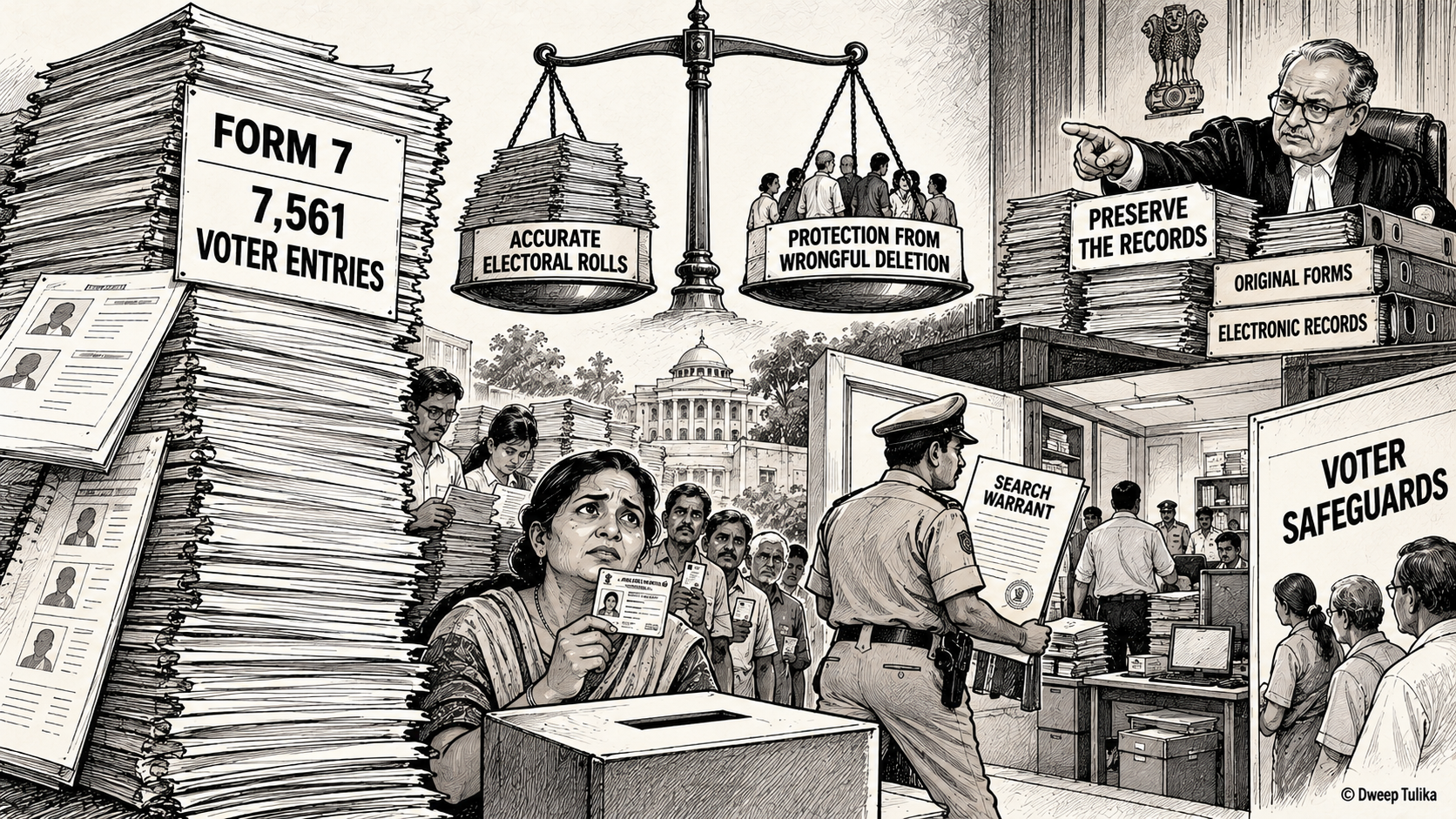
On October 5, Karnataka Police obtained a court-authorised search warrant for the office of Motkar Srinivas, a BJP corporator and booth-level agent in Ballari. The warrant followed a complaint alleging an attempt to remove eligible voters from the electoral roll through a bulk submission of objections.
The development comes amid complaints from other parts of Karnataka about Form 7 applications submitted during the Special Intensive Revision (SIR) of electoral rolls. The BJP has challenged criminal proceedings against its booth-level agents, arguing that filing objections is part of the electoral process. The allegations of wrongdoing remain subject to investigation and the prescribed electoral procedures.
Ballari: The dispute over 7,561 voters
According to Hindustan Times and The News Minute, Srinivas submitted representations to election authorities in September seeking re-verification of 7,561 voter entries in the Ballari City Assembly constituency. The grounds reportedly included voters being absent, having shifted residence or being registered elsewhere.
Election authorities initially rejected the request, citing insufficient supporting information, according to reports. Srinivas subsequently sought further action concerning the entries.
Congress booth-level agent Gautham S. lodged a complaint alleging that the submissions could result in the unlawful exclusion of eligible voters. An FIR was registered on October 1, and police later obtained a warrant to search Srinivas’s office on Talur Road for records and other material connected with the submissions.
The complaint also named election officials, according to The News Minute. The allegations against those named have not been established as findings of guilt.
The figure of 7,561 refers to voters whose entries were targeted for re-verification or objection, according to the reports. It does not mean that all 7,561 names were deleted, nor does it establish that every objection was fraudulent. Those questions require examination of the original applications and official records.
What is Form 7, and how can it be misused?
Form 7 is used to object to the inclusion of a name in an electoral roll or to seek deletion of an existing entry on legally recognised grounds. Electoral authorities must examine objections under the applicable rules before deciding whether a name should be removed.
The Karnataka controversy centres on allegations that bulk applications included unsupported claims that voters were absent or had permanently shifted residence. In other cases, complainants have alleged false information or forged signatures. These remain allegations to be tested through the relevant procedures.
On October 1, Karnataka Chief Electoral Officer V. Anbukkumar reportedly directed electoral registration officials to initiate legal proceedings against applicants found, after the prescribed inquiry, to have knowingly made false statements or declarations in electoral forms. The directive reportedly covered Forms 6, 6A, 7 and 8 and referred to Section 31 of the Representation of the People Act, 1950.
The directive did not establish that the disputed applications in any particular case were fraudulent or that a specific political party was responsible for wrongdoing. Its stated purpose was to address knowingly false declarations through the applicable legal process.
October 14: High Court maintains interim stay in separate cases
The legal dispute widened after the Karnataka High Court on October 14 declined to vacate its interim stay on investigations involving two BJP booth-level agents, G. S. Vasanthalakshmi and Deepak Singh R.
The separate cases concern Form 7 submissions relating to 778 voters and 136 voters, respectively, in the Malleswaram Assembly constituency.
The petitioners argued that the competent electoral authorities should first decide the validity of the disputed objections under the election rules. They also challenged the legal basis for the police investigations.
The state government, represented by Advocate-General Shashikiran Shetty, argued that an investigation was necessary to examine allegations involving impersonated identities and knowingly false information.
The court maintained the interim stay while directing that the original Form 7 applications and relevant electronic records held by electoral registration officers be preserved and made available to the investigating officer.
The order concerns the sequence in which electoral objections and criminal investigations should be handled. It is an interim order, not a final determination of the allegations.
The October 14 order concerns the separate Malleswaram cases. It should not be interpreted as a stay in the Ballari case involving Srinivas.
Bulk withdrawals in three districts raise further questions
A report published by The Times of India on October 15 said bulk Form 7 applications in Belagavi, Bidar and Vijayapura had been withdrawn, returned or rejected at preliminary stages.
The report raised questions about whether the withdrawal or preliminary rejection of applications could limit further scrutiny of whether the original objections were properly supported. The precise circumstances and status of the applications may differ across the districts.
A withdrawal or preliminary rejection does not, by itself, prove that an application was fraudulent. Establishing whether a declaration was knowingly false requires evidence and the applicable inquiry.
The developments nevertheless add to questions about how electoral authorities should document bulk objections, verify the identities and declarations of applicants, and ensure that procedural withdrawals do not obscure relevant evidence where a lawful inquiry is warranted.
Political dispute over the investigations
The BJP has opposed criminal cases against its booth-level agents over Form 7 submissions, maintaining that party agents are entitled to raise objections through the prescribed electoral process. Congress representatives have alleged that bulk objections were used in an attempt to remove eligible voters.
These positions reflect competing claims in the dispute; neither establishes the validity of the disputed forms or the guilt of the people named in the complaints.
The central legal distinction is between the right to submit a legitimate objection and the alleged use of false information, impersonation or forged signatures. The first is part of electoral-roll administration; the second, if proved, may attract legal consequences.
What remains unresolved
The Ballari investigation, the separate Malleswaram proceedings and the reports of bulk withdrawals in three other districts involve distinct facts and procedural stages. They should not be treated as one consolidated case.
Key questions include whether the disputed applications were supported by verifiable evidence, whether any eligible voters were actually removed, whether signatures or identities were falsified, and how electoral authorities handled the objections.
The Karnataka High Court’s interim directions in the Malleswaram cases require records to be preserved while the legal proceedings continue. The Ballari case remains a separate matter, and the search warrant is an investigative step rather than a finding of guilt.
The wider issue is how electoral authorities can maintain accurate voter lists while protecting eligible citizens from wrongful exclusion—and how allegations of misuse can be investigated without treating every objection as fraudulent or every bulk submission as legitimate.
Sources: Hindustan Times, October 5–6, 2026; The News Minute, October 2026; The Indian Express, October 9 and 14, 2026; The Times of India, October 15, 2026. Allegations are attributed to complainants or reported sources and should not be read as established findings of guilt.