
SRI VIJAYA PURAM | OCTOBER 21, 2026 | DWEEP TULIKA | CULTURE
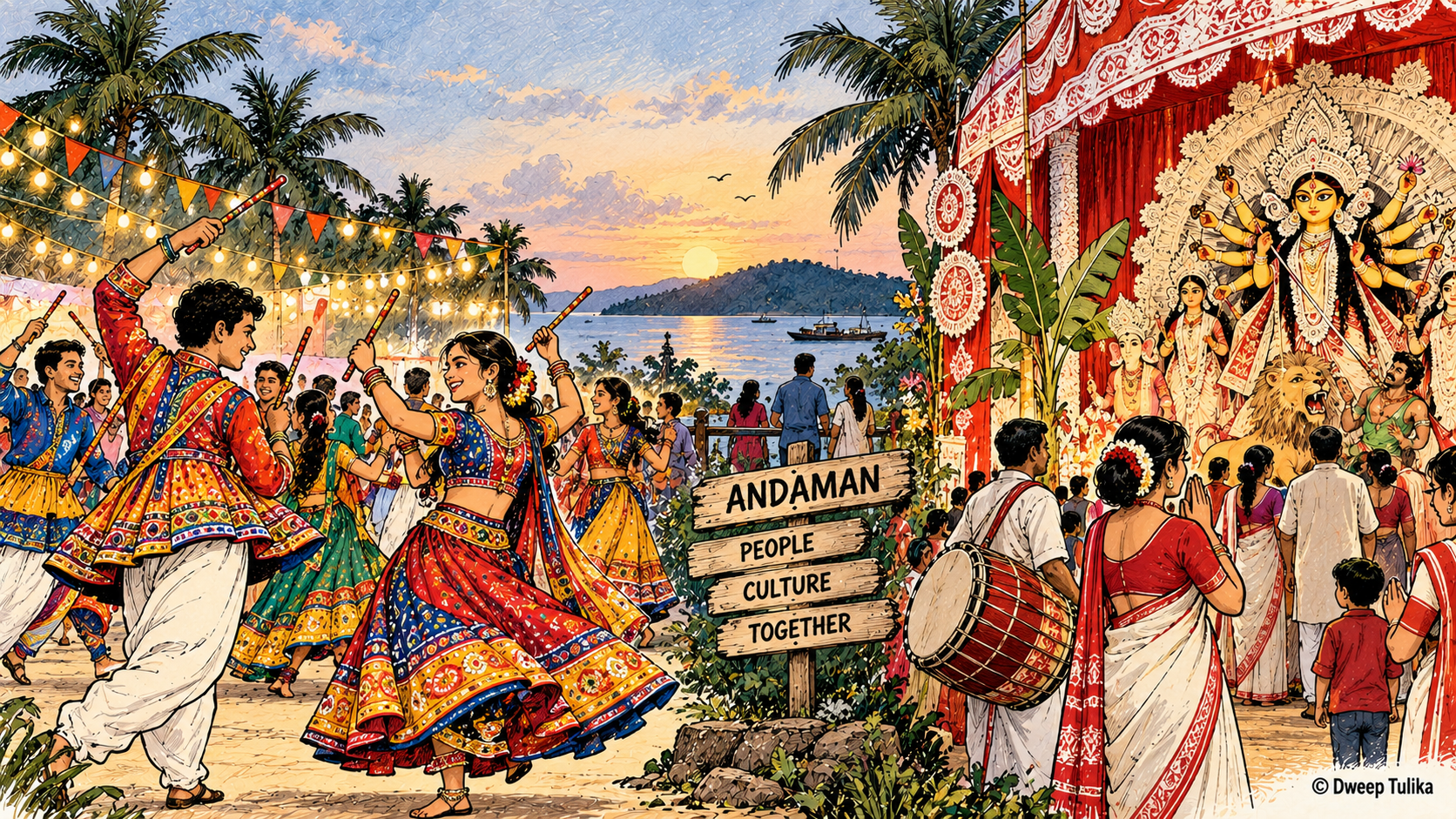
The Administration-organised Dandiya Mahotsav at ITF Ground has brought a Gujarati-associated Navratri tradition into sharper focus in Andaman, raising questions about cultural exchange in an island society where Bengali Durga Puja has deep-rooted traditions.
The Department of Art and Culture, Andaman and Nicobar Administration, organised the Dandiya Mahotsav at ITF Ground in Sri Vijaya Puram on October 11, 2026. Local reports described it as the first such festival organised there by the Administration. Lieutenant Governor Dr Dinesh Sharma attended as chief guest, alongside Member of Parliament Bishnu Pada Ray and other dignitaries.
The event gave Dandiya a prominent public platform during Sharad Navratri. It also brought into focus a wider cultural question: how do traditions associated with particular regions find audiences elsewhere, and what makes people participate in festivals beyond their own family or community backgrounds?
The question is not whether Dandiya belongs in Andaman. Rather, it is about how cultural practices travel, attract new participants and become part of the social life of a diverse society.
Durga Puja and Andaman’s Bengali Cultural Roots
Durga Puja occupies a prominent place in Andaman’s cultural landscape, particularly in Sri Vijaya Puram and parts of North and Middle Andaman. Bengali communities have played a significant role in sustaining the festival through community pujas, decorated pandals, cultural performances, traditional music and idol immersion.
For many Bengali families, Durga Puja is more than a religious observance. It is an annual gathering that brings together relatives, friends and neighbourhoods while preserving artistic, musical and cultural traditions across generations.
The festival also attracts participation from people belonging to other communities, reflecting the shared character of public celebrations in the islands.
Against this backdrop, Dandiya nights offer a different form of festive participation. While Durga Puja combines religious rituals, artistic displays and community organisation, Dandiya places coordinated dance and music at the centre of the experience.
The presence of both traditions raises questions about what attracts people to particular events, how cultural preferences develop and how new experiences become part of an established festive environment.
From Gujarat to the Islands
Dandiya Raas is a traditional dance form particularly associated with Gujarat and widely performed during Navratri. Participants use decorated sticks, moving rhythmically in pairs or groups to music. The dance is often accompanied by colourful traditional attire and lively musical performances.
Over time, Dandiya and Garba celebrations have spread beyond Gujarat through community associations, cultural organisations, public events, popular entertainment and social media.
Andaman has seen examples of this cultural exchange in different settings. In August 2026, local reporting described a Garba workshop in Sri Vijaya Puram that brought together participants of different ages. In September 2025, children at Balika Niketan, Attam Pahad, performed Garba during a Navratri and Durga Puja programme.
The October 2026 Dandiya Mahotsav added another example: a major public event organised by the Administration at ITF Ground.
These reports establish that Gujarati-associated Navratri dance traditions have featured in organised cultural activities in the islands. They do not, however, establish a consistent year-on-year increase in the number of events, participants or public interest.
That distinction matters. A high-profile event can increase a tradition’s visibility, but visibility alone does not prove sustained growth in participation.
Why Might Dandiya Be Attracting Attention?
Several factors may help explain why Dandiya celebrations appeal to people beyond their traditional regional base. Their precise influence in Andaman, however, requires further local evidence.
A participatory experience
Dandiya is built around collective movement and rhythmic interaction. Rather than experiencing a programme solely as a spectator, participants can join the dance, learn the steps and become part of the celebration. This interactive format may appeal to people unfamiliar with Gujarati customs.
Music and popular culture
Navratri music and Dandiya performances are widely encountered through films, television, online videos and social media. Such exposure may encourage people to experience the dance in person, even without a direct family or regional connection to Gujarat.
A social gathering
Organised Dandiya nights can provide opportunities for friends, families and colleagues to gather in a festive setting. Music, dance and traditional clothing can make these events attractive social experiences for people from different backgrounds.
Public and institutional support
The Department of Art and Culture’s organisation of the Dandiya Mahotsav gave the tradition a prominent public platform. Institutional support can introduce cultural forms to wider audiences and create opportunities for people to participate across community boundaries.
These are possible explanations, not established findings about the motivations of Andaman’s residents. Interviews with organisers and attendees, along with attendance records, would help establish which factors matter most locally.
Does Cultural Popularity Depend on Population Size?
One intriguing question is whether the popularity of a cultural practice corresponds to the size of the community from which it originated.
Bengali culture has a strong historical presence in Andaman, and Durga Puja has an established network of community celebrations. Dandiya, meanwhile, is particularly associated with Gujarat but can attract participants from many backgrounds.
This highlights an important distinction: the reach of a cultural activity does not necessarily correspond to the size of the community that historically practises it.
A dance form may gain wider acceptance because of its music, accessibility, social appeal or exposure through popular culture. People can participate in a tradition without belonging to the community most closely associated with it.
At the same time, claims about the relative sizes of Gujarati, Marwari and Bengali communities in Andaman require reliable demographic evidence. Census mother-tongue data alone cannot establish the current size of communities identified by regional or social background.
The more useful question is how cultural practices reach people, what encourages participation and whether occasional interest develops into a sustained tradition.
Is Dandiya Competing With Durga Puja?
The growing visibility of Dandiya need not be interpreted as a challenge to Bengali Durga Puja. The two traditions have different cultural expressions and offer different forms of participation.
Durga Puja combines religious rituals, artistic displays, community organisation and cultural programmes. Dandiya nights place coordinated dance and music at the centre of the experience. People may enjoy both traditions for different reasons; participation in one does not automatically imply reduced interest in the other.
Nevertheless, the development offers an opportunity for cultural organisations to consider how established celebrations can remain engaging for younger generations.
Bengali cultural associations can continue nurturing traditional music, dance, theatre, literature and other artistic forms while creating opportunities for younger people to participate actively. Such efforts can help ensure that cultural heritage remains a living practice rather than simply a memory passed down through generations.
This does not require competing with other festivals. It requires recognising that traditions survive through continued participation, meaningful experiences and the willingness of communities to pass them on.
A Changing Cultural Landscape
Andaman’s cultural identity has been shaped by communities from different parts of India, alongside the islands’ Indigenous communities and their distinct histories. Its cultural life reflects a range of traditions rather than a single regional identity.
The Administration-organised Dandiya Mahotsav in October 2026 offers a documented example of a regional festive tradition receiving a prominent public platform in Sri Vijaya Puram. Earlier Navratri-related activities also show that these dance traditions have appeared in different local settings.
Whether these developments represent sustained year-on-year growth remains to be established through event records, attendance figures and interviews with organisers and participants. What can be said is that Dandiya and Garba have featured in the islands’ contemporary cultural activities.
The larger question is how Andaman can welcome new cultural experiences while sustaining its established traditions. A multicultural society need not choose between preserving its heritage and embracing the practices of other communities.
Dandiya’s presence does not diminish the cultural significance of Bengali Durga Puja. Instead, it offers an opportunity to examine how traditions travel, how people connect through festivals and how cultural identities evolve in a diverse island society.
Ultimately, the strength of Andaman’s cultural life will depend not on which festival attracts the most attention, but on whether its many traditions continue to be practised, shared and passed on to future generations.