
NEW DELHI | OCTOBER 22, 2026 | DWEEP TULIKA | INVESTIGATIONS
Released emails, calendar entries and a photograph have brought renewed scrutiny to Union Minister Hardeep Singh Puri’s association with Jeffrey Epstein, the American financier and convicted sex offender. The documentary record shows repeated contact between the two men, including professional networking, a visa-related request and appointments at Epstein’s Manhattan residence.
An examination of the three supplied records—EFTA00368287, EFTA00451729 and EFTA01191284—alongside published reporting, documents several interactions between 2014 and 2017. The records provide a basis for examining the nature and extent of the relationship, but they do not establish that Puri participated in Epstein’s sexual crimes.
The photograph that renewed scrutiny
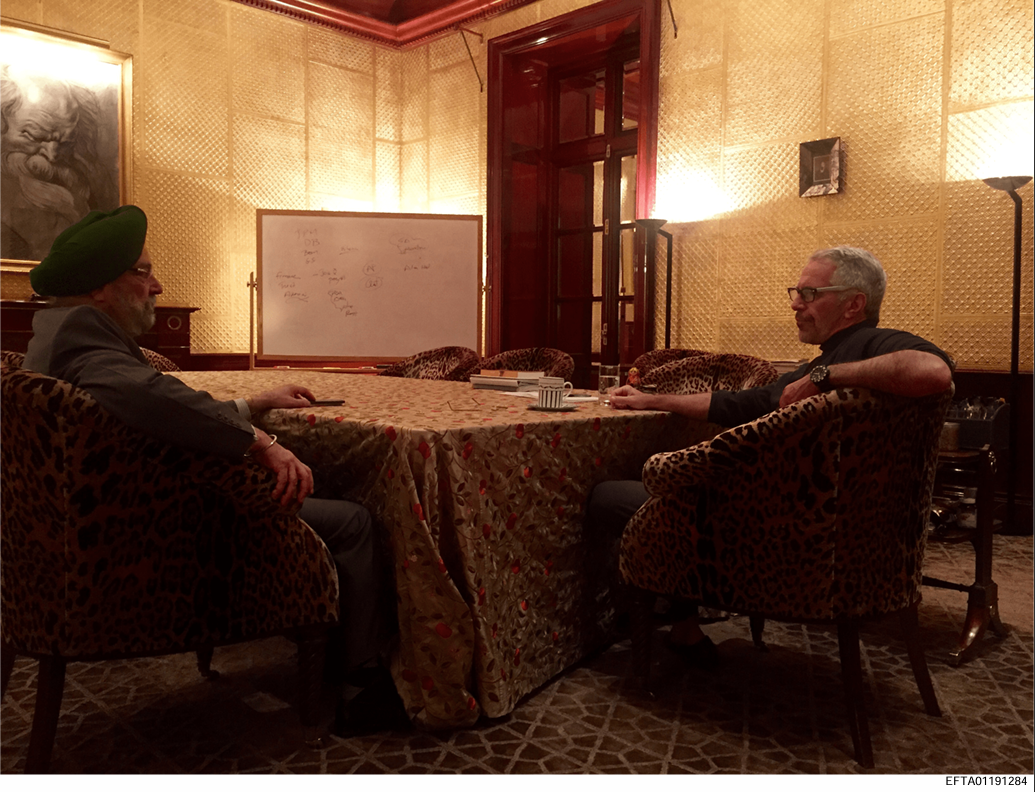
A photograph identified in the supplied material as EFTA01191284 shows Puri seated opposite Epstein across a table. The image has drawn attention because it offers a visual record of an encounter between the two men.
The photograph alone, however, does not establish the location, the date or the full attendance at the meeting. Although the two men are visible in the frame, it cannot establish whether other people attended the wider meeting before or after the photograph was taken.
Puri has acknowledged meeting Epstein and described their interactions as professional. He has said the contacts arose through his work with the International Peace Institute and related diplomatic circles. His office has also argued that meeting Epstein in a professional context does not establish wrongdoing.
Those explanations need to be assessed against the documentary record, rather than accepted or rejected on the basis of the photograph alone.
June 2014: A calendar entry involving Terje Rod-Larsen
One of the supplied records, EFTA00368287, contains a schedule circulated by Epstein’s assistant, Lesley Groff, in June 2014.
The calendar for Sunday, June 8, lists an appointment from 1:30 p.m. to 3 p.m. described as “Appt w/Hardeep and Terje.” The reference is consistent with Terje Rød-Larsen, the Norwegian diplomat and former president of the International Peace Institute, whom Puri has identified as the intermediary through whom he first met Epstein.
The following day’s schedule also contains an appointment beginning “Appt w/Hardeep and,” followed by a redacted name. The available entry does not establish the identity of that person.
These records are consistent with Puri’s account that at least some of his contacts arose through professional and diplomatic networks. They do not establish that every subsequent meeting involved a delegation or multiple attendees.
Reid Hoffman and India’s technology investment potential
A significant part of the correspondence concerns Reid Hoffman, the LinkedIn co-founder, and the potential for investment in India’s technology sector.
Published reporting describes Epstein introducing Puri to Hoffman in September 2014. Subsequent correspondence concerned a possible visit to India and the country’s expanding internet economy. Puri discussed the newly elected government’s economic priorities, rural connectivity and the potential for internet-based businesses.
This correspondence provides a documented professional context for part of the relationship. Puri has said he was promoting Indian business opportunities and seeking to connect technology-sector figures with the country.
That context is relevant, but it does not automatically explain every interaction recorded in the emails and calendars.
December 2014: The “exotic island” email
In an email dated December 24, 2014, Puri wrote to Epstein:
“Please let me know when you are back from your exotic island.”
He also expressed an interest in meeting for a conversation and bringing books that might encourage Epstein’s interest in India. Epstein replied that he had been speaking with Hoffman, and the exchange continued in a familiar tone.
The wording establishes that Puri referred to Epstein’s time away on an island and sought to arrange another conversation after his return. It does not, on its own, establish that Puri visited the island, knew about criminal activity there or was aware of the full extent of Epstein’s crimes.
Puri has denied visiting Epstein’s island. The location of the photograph discussed in this report has also not been independently established through the supplied material.
The email is therefore relevant to understanding the correspondence, but it cannot resolve questions about travel or knowledge without corroborating records.
A visa-related request for Epstein’s assistant
Another email exchange, reported by The Indian Express and The Wire, concerns a request from Epstein for help with a visa for his assistant, who wanted to attend a wedding in India.
The correspondence shows Puri forwarding the request to former diplomat Parmod Bajaj and asking for the matter to be handled on a “priority basis.” The subsequent exchange referred to the online application process and further assistance.
The email demonstrates that Epstein approached Puri with an administrative request and that Puri connected him with a professional contact.
The correspondence cited in the published reports does not, by itself, establish that a visa was improperly issued or that immigration procedures were bypassed. Puri has explained that he referred the request to people who could advise on the application process.
The exchange is nevertheless relevant because it shows that the correspondence was not limited to the promotion of India’s technology sector.
Scheduled meetings at Epstein’s Manhattan residence
Published reporting by The Wire describes appointments at Epstein’s Manhattan townhouse on February 4, 2015, January 6, 2016, and May 19, 2017. The arrangements were made through Epstein’s assistant, Lesley Groff.
The appointments are significant because they document plans to meet at Epstein’s private residence, rather than merely referring to contact at a public or institutional event.
A scheduled appointment is evidence that a meeting was planned; it does not independently establish the full conversation, the purpose of the meeting or who was present throughout.
The questions are straightforward: what was discussed at each appointment, who attended, and how did the meetings relate to the professional networking documented in earlier correspondence?
Those questions require the complete email threads, related calendars and any other contemporaneous records available.
May 2017: An invitation to another potential attendee
The supplied record EFTA00451729 contains an email dated May 18, 2017. Epstein wrote to businessman Joshua Cooper Ramo, copying his assistant, and said that Puri would be coming the following morning at 10:30. Epstein asked whether Ramo was interested in joining.
The email establishes that Epstein informed another person of the planned visit and offered him the opportunity to attend. It does not establish that Ramo accepted the invitation or was present at the meeting.
The distinction matters when assessing public explanations about whether particular encounters were one-to-one or involved other participants. Attendance must be established separately for each meeting.
Was the photograph taken on Epstein’s island?
Speculation about the photograph’s location has focused on the room’s furnishings and decoration. The supplied image shows patterned walls, animal-print upholstery, a doorway, a whiteboard and framed artwork.
Those details may provide leads for further research, but visual resemblance alone is not sufficient to identify a room or property. The supplied photograph does not visibly establish its location through an address, venue label or independently verified metadata.
A defensible identification would require comparison with authenticated reference photographs and distinctive fixed features, alongside reliable evidence establishing where those reference images were taken.
Until that work is completed, the claim that the photograph was taken on Little St. James remains unverified.
What the records establish—and what they do not
Taken together, the supplied documents and published reporting support several conclusions.
First, Puri and Epstein had repeated contact, including email exchanges, scheduled appointments and a photographed encounter.
Second, some correspondence concerned efforts to connect Reid Hoffman with India’s technology and investment opportunities.
Third, the exchanges also included a visa-related request and a reference to Epstein’s island.
Fourth, the calendar entry involving “Hardeep and Terje” is consistent with Puri’s account that professional networks played a role in his introduction to Epstein.
Finally, the available photograph and appointment records do not independently establish the purpose or full attendance of every meeting.
The documents examined do not establish that Puri participated in Epstein’s sexual crimes. Equally, the existence of a professional explanation for part of the relationship does not remove the need to examine other documented interactions.
Questions that remain
Several questions warrant further investigation:
What was discussed at each scheduled appointment at Epstein’s Manhattan residence?
Which meetings involved Rød-Larsen or other participants, and who attended each one?
Did Joshua Cooper Ramo accept Epstein’s invitation to join the May 2017 meeting?
What was the full context of the December 2014 reference to Epstein’s island?
Can the photograph’s location be established through authenticated images or independent records?
Are there additional calendar entries, meeting notes or correspondence that clarify the purpose of the visits?
The answers should be sought through original records, independent corroboration and requests for comment from the people involved.
Conclusion: Follow the records, not assumptions
The available documentary trail shows that Puri’s association with Epstein extended beyond a single encounter. It included professional introductions, correspondence about India’s technology sector, a visa-related request and scheduled meetings over several years.
Puri has described the contacts as professional and denied visiting Epstein’s island. Those statements form part of the public record and should be assessed alongside the underlying documents.
The central public-interest question is whether the explanations offered account for the full documentary timeline. Resolving that question requires authenticated records, a careful assessment of each meeting and clear answers from the people involved.
The evidence warrants scrutiny of the relationship’s nature and extent. It does not justify treating association as proof of participation in Epstein’s crimes.
Dweep Tulika Investigations
Documents and reporting consulted
US Department of Justice Epstein-related records supplied for this report: EFTA00368287, EFTA00451729 and EFTA01191284.
The Wire, reporting on the photograph, correspondence and scheduled meetings.
The Indian Express, reporting on the visa-related email and Reid Hoffman correspondence.
The US Department of Justice’s official Epstein Library.