
THE HEADLINE PRIME MINISTER | PART 4 OF 7
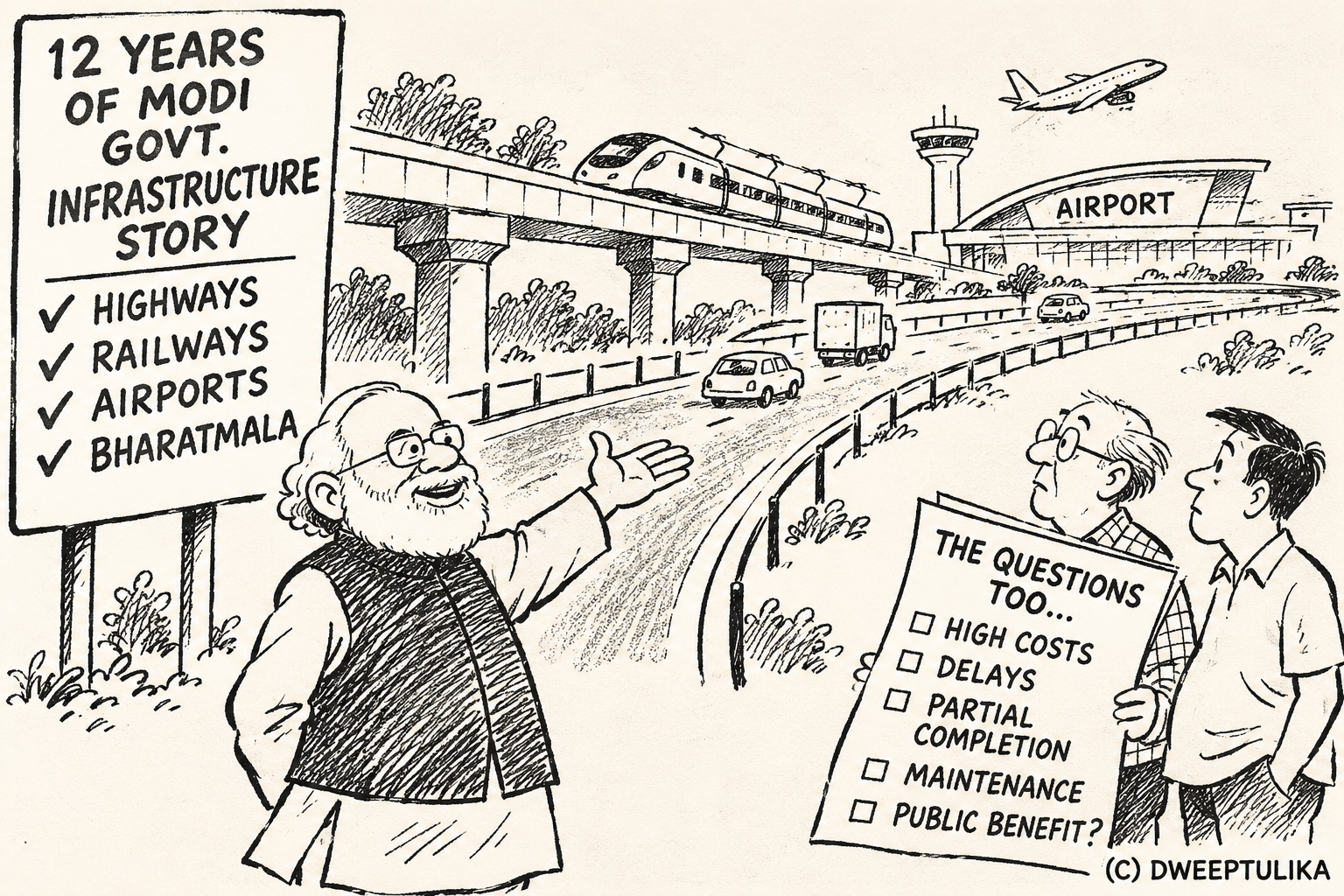
Roads, railways, airports and public infrastructure under 12 years of Narendra Modi's leadership: the achievements, the costs and the questions that remain.
By Dweep Tulika | Investigative Editorial
Introduction: Beyond the inauguration
Infrastructure has become one of the most visible elements of India's development story under Prime Minister Narendra Modi. Expressways, modern railway stations, Vande Bharat trains, expanded airports and major transport corridors feature prominently in the government's account of its achievements since 2014.
There is substantial evidence of expansion. India's national highway network has grown, railway electrification has advanced considerably, and the number of operational airports has increased.
These developments can improve connectivity, reduce travel times, facilitate trade and open opportunities for communities previously underserved by transport infrastructure.
But the number of projects announced or inaugurated does not, by itself, establish how much development has been delivered.
A road may be completed but remain poorly maintained. A highway may reduce travel time while imposing toll costs on regular users. An airport may become operational without sustaining the passenger traffic needed to support regular services. A railway may receive new technology while still facing maintenance and safety challenges.
This fourth instalment of The Headline Prime Minister examines five areas: highways, railways, airports, project costs and public accountability.
The objective is to distinguish documented expansion from actual outcomes, without assuming that every project is successful or that every implementation problem negates the benefits of infrastructure investment.
1. National highways: A substantial expansion
The Ministry of Road Transport and Highways reported that India's national highway network expanded from 91,287 kilometres in 2014 to 1,46,572 kilometres by March 2026—an increase of approximately 61%.
The length of four-lane and wider national highways increased from 18,371 kilometres in 2014 to 45,516 kilometres by March 2026. The government also reported that 3,644 kilometres of access-controlled high-speed corridors and expressways had been operationalised.
These figures demonstrate a substantial expansion of national highway infrastructure. Better roads can reduce journey times, improve freight movement, connect production centres to markets and make travel more reliable.
The Ministry's published construction figures also show that the pace of highway building increased substantially during several years of the period under examination.
However, national highway length is an output measure, not a complete measure of public benefit.
It does not tell us how much travel time has been saved across the network, how many villages gained reliable access, whether road quality has improved consistently, or whether transport costs have fallen for businesses and households.
The distinction between road construction and improved mobility is particularly important. A completed road may generate substantial benefits where it removes a bottleneck, but the benefit depends on connections to local roads, bridges, logistics facilities and the destinations people need to reach.
What the evidence establishes: The national highway network and the length of four-lane and wider highways expanded substantially between 2014 and March 2026.
What remains to be established: How these additions affected journey times, freight costs, road conditions, safety and access for different communities.
Source: Ministry of Road Transport and Highways — Year-End Review 2025; PIB — National highway development, June 2026.
2. Bharatmala: Ambition, expenditure and implementation questions
Bharatmala Pariyojana was designed to improve highway connectivity through economic corridors, inter-corridor routes, feeder roads, coastal and port connectivity, border roads and expressways.
The programme's first phase was approved with a planned length of 34,800 kilometres and an estimated cost of ₹5.35 lakh crore.
According to a Ministry of Road Transport and Highways statement in December 2024, projects covering 26,425 kilometres had been awarded and 18,714 kilometres constructed as of 31 October 2024.
Calculated against the original planned length, approximately 75.9% had been awarded and 53.8% constructed by that date. These are indicative comparisons with the original programme length, not the percentage of all expenditure completed or a final assessment of the programme.
The difference between awarded and constructed length demonstrates why project announcements and contracts should not be treated as completed infrastructure.
What did the CAG find?
The Comptroller and Auditor General's 2023 performance audit of Bharatmala Phase I identified concerns involving project prioritisation, appraisal, tendering and cost management.
According to the audit findings summarised by PRS Legislative Research, by March 2023 approximately 46% of the length of 11 high-priority Bharatmala corridors had not been awarded. The audit also raised concerns about increases in sanctioned costs, the relationship between approved funding and project awards, and the appraisal of selected projects.
The CAG reported that the average sanctioned cost per kilometre had increased from ₹14 crore to ₹24 crore in the projects examined. It also found that 35 of the 50 sampled projects had gone to tender without appraisal by the designated Project Appraisal and Technical Scrutiny Committee.
These findings concern the programme and projects examined in the audit. They should not be interpreted as evidence that every Bharatmala project was mismanaged or that the entire programme failed.
Nevertheless, they raise important questions about how major infrastructure projects are prioritised, assessed and monitored.
What the evidence establishes: Bharatmala has delivered substantial highway construction, but the official progress figures show a gap between the planned network, awarded projects and constructed roads. The CAG also documented project-management and cost-estimation concerns.
What remains to be established: The programme's final costs, the extent to which projects have achieved their intended economic benefits, and whether the audit's recommendations were fully implemented.
Sources: Ministry of Road Transport and Highways — Bharatmala progress, December 2024; CAG Performance Audit on Bharatmala Phase I; PRS Legislative Research — Audit findings.
3. Indian Railways: Electrification and modernisation
Railway electrification is one of the clearest examples of large-scale infrastructure expansion during the period under review.
According to the Ministry of Railways, approximately 21,801 route kilometres of the broad-gauge network had been electrified by 2014. By March 2026, the figure had reached 69,873 route kilometres out of a total broad-gauge network of 70,142 kilometres, equivalent to approximately 99.6%.
This represents a major transformation in the railway network.
Electrification can reduce dependence on diesel, improve operational efficiency and support lower operating costs where the electricity supply and railway operations are appropriately managed. The government has also reported substantial savings in diesel consumption and expenditure following electrification.
The broader railway modernisation programme includes upgraded signalling, track renewal, station redevelopment, new rolling stock and improved passenger services.
These developments should be assessed separately rather than combined into a single modernisation figure. Electrification measures the proportion of track equipped for electric traction; it does not, by itself, measure punctuality, passenger comfort, capacity or safety.
What about railway safety?
Infrastructure development must be accompanied by effective maintenance and safety systems.
The CAG's 2022 performance audit on derailments examined the period April 2017 to March 2021. It identified concerns involving track-maintenance practices, inspections, the use of track-maintenance machinery and the availability and utilisation of funds for safety-related works.
A subsequent CAG report on railway signalling in South Western Railway examined maintenance and reliability issues, including delays in upgrading certain signalling installations. These findings relate to the audited period and locations, rather than establishing the condition of every railway route today.
They nevertheless demonstrate why new technology and expanded infrastructure must be accompanied by adequate maintenance, inspections and timely safety upgrades.
What the evidence establishes: Railway electrification has expanded from approximately 31% of the broad-gauge route network in 2014 to 99.6% by March 2026. Audit reports have also identified specific maintenance and signalling issues requiring attention.
What remains to be established: The extent to which infrastructure expansion has improved passenger outcomes across the network, and how effectively maintenance and safety recommendations have been implemented.
Sources: Ministry of Railways — Electrification progress, March 2026; CAG — Performance Audit on Derailments in Indian Railways; CAG — Railway signalling audit, Report No. 24 of 2025.
4. Airports and regional connectivity: More airports, but are services sustainable?
The Ministry of Civil Aviation reported that India's airport network expanded from 74 operational airports in 2014 to 164 in 2025.
The expansion includes new airports, the revival of previously underserved facilities and the development of terminals and other airport infrastructure.
The Regional Connectivity Scheme, UDAN, was introduced to improve air access to underserved and unserved destinations. By March 2025, the government reported the operationalisation of 625 routes and the activation of 88 unserved or underserved airports, including heliports and water aerodromes.
The government's 2025–26 performance reporting also records further developments in the airport network and regional connectivity.
The expansion can create opportunities for tourism, business travel, medical access and regional economic activity. Improved air connections can be particularly valuable for geographically isolated regions.
But the number of operational airports is not the same as the number of airports with frequent, affordable and commercially sustainable services.
An airport may be operational while having limited routes or infrequent flights. Routes launched under a connectivity scheme may also be discontinued if services cannot be sustained.
A proper assessment therefore needs passenger traffic by airport, the frequency and continuity of routes, fares, public subsidy, operating costs and the number of passengers who actually benefit from improved access.
The government reported that scheduled domestic airlines carried 165.5 million passengers in financial year 2024–25, compared with 153.7 million in 2023–24. This provides evidence of growing passenger traffic nationally, but it does not establish that the benefits were distributed evenly among regions or income groups.
What the evidence establishes: The airport network has expanded considerably, and domestic passenger traffic increased in 2024–25.
What remains to be established: Whether newly connected regions have reliable, affordable and sustained services, and how much economic benefit reaches local residents.
Sources: Ministry of Civil Aviation — Performance and connectivity; PIB — UDAN and regional connectivity.
5. Public money: How much does infrastructure actually cost?
Infrastructure is capital-intensive. Roads, railway lines, airports and large public projects require substantial expenditure, often over several years.
The government's project-monitoring system, administered by the Ministry of Statistics and Programme Implementation, tracks central-sector projects costing ₹150 crore and above.
Its data for June 2026 showed 1,847 ongoing projects across 17 central ministries and departments, with a revised cost of ₹40.54 lakh crore. Expenditure recorded against these projects had reached ₹21.97 lakh crore.
The amount spent was equivalent to approximately 54.2% of the revised aggregate cost. However, this is a comparison of expenditure with revised cost, not a measure of the percentage of projects physically completed. Financial progress and physical progress are different indicators.
The government reported that approximately 709 projects had exceeded 80% physical progress. The figures also show that a substantial portfolio of large projects remained under implementation.
This does not necessarily indicate failure: major projects naturally take time to complete. But the scale of expenditure makes monitoring essential.
The investigation must examine original and revised project costs, completion dates, actual expenditure, physical progress, delays, contract variations and the public benefits achieved.
It must also distinguish between money allocated in a budget, money released, money spent and the final value of the infrastructure delivered.
A project that costs more than originally estimated is not automatically wasteful. Changes in scope, land acquisition, inflation and unforeseen conditions can affect costs. The relevant questions are whether the changes were justified, transparently recorded and accompanied by adequate public value.
What the evidence establishes: The central government is monitoring a substantial portfolio of large infrastructure projects, with considerable expenditure already recorded and many projects still under implementation.
What remains to be established: Project-by-project cost overruns, delays, final expenditure and the extent to which the delivered infrastructure achieves its intended outcomes.
Source: MoSPI — Infrastructure and Project Monitoring.
6. Who actually benefits from infrastructure?
National infrastructure statistics tell us how much has been built, but they do not reveal how benefits are distributed among citizens.
A new highway may benefit freight operators, industrial centres, commuters and nearby businesses. It may also impose toll charges, require land acquisition or divert traffic away from existing settlements.
An airport may improve access for tourists and business travellers, while its direct benefits to residents depend on flight availability, fares, employment opportunities and connections to surrounding communities.
Railway modernisation can improve travel and operational efficiency, but its benefits depend on service availability, affordability, capacity and the needs of different passenger groups.
The same project may produce different outcomes for different communities.
To understand the distribution of benefits, this investigation will examine:
Geographical reach: which states, districts and communities gained improved connectivity.
Affordability: whether the service is accessible to lower-income households.
Economic outcomes: changes in travel time, freight costs, employment and local business activity.
Public costs: expenditure, tolls, maintenance and subsidies.
Social and environmental effects: land acquisition, displacement and environmental impacts where documented.
Long-term performance: whether the infrastructure remains operational, safe and useful after inauguration.
These measures are necessary to move beyond the number of projects completed towards an assessment of their effect on people's lives.
7. Infrastructure publicity: What should a headline figure mean?
Government announcements often emphasise kilometres of roads, numbers of airports, electrification rates or the inauguration of major projects.
Such figures can be valid and useful. The issue is whether they are presented with enough context to support the conclusion being drawn.
For each major infrastructure claim, Dweep Tulika will examine whether the figure refers to a project announced, approved, awarded, under construction, completed or operational.
We will also distinguish cumulative achievements from annual additions, and assess whether the baseline and reporting dates are comparable.
For example, the number of operational airports is different from the number of new airports built entirely from scratch. Similarly, the length of highway awarded under contract is not the same as the length constructed, and the proportion of railway lines electrified does not measure the condition of the tracks or the quality of passenger services.
The same standard applies to criticism. A cost increase or audit observation must be explained in its proper context rather than used to imply that every infrastructure project has failed.
The purpose is to ensure that both achievements and shortcomings are represented accurately.
Conclusion: Built, delivered and useful are three different tests
The evidence examined in this article shows that India has substantially expanded its national highway network, accelerated railway electrification and increased the number of operational airports.
These are measurable developments with the potential to improve connectivity, support economic activity and widen access to transport.
At the same time, official progress figures show that major programmes contain projects at different stages of completion. The CAG has identified concerns involving Bharatmala project appraisal and costs, railway maintenance and signalling, while project-monitoring data show the scale and complexity of the central government's ongoing infrastructure portfolio.
These findings do not negate the achievements. They establish why infrastructure must be assessed on more than the number of kilometres constructed or facilities inaugurated.
The next stage of scrutiny must examine the final cost, operational performance, safety, accessibility and distribution of benefits. It must also distinguish the Union government's role from the responsibilities of state governments, public-sector agencies, contractors and private operators.
Ultimately, infrastructure development is not measured solely by what appears in an inauguration ceremony. It is measured by whether the completed asset works, whether people can afford to use it, whether it remains safe and maintained, and whether it delivers the benefits for which public money was committed.
The central question is not only what India built over 12 years, but what was delivered, at what cost, and how much it improved people's lives.
The Headline Prime Minister will continue to examine these questions through official statistics, audit findings and transparent comparisons.
Series: The Headline Prime Minister | Part 4 of 7 | Dweep Tulika Editorial
Editorial note: Figures in this article refer to the dates and definitions specified by the cited sources. Awarded projects, completed infrastructure, operational facilities, financial expenditure and measured public outcomes are different indicators and should not be treated as interchangeable.