
NEW DELHI | OCTOBER 20, 2026 | DWEEP TULIKA | EDUCATION
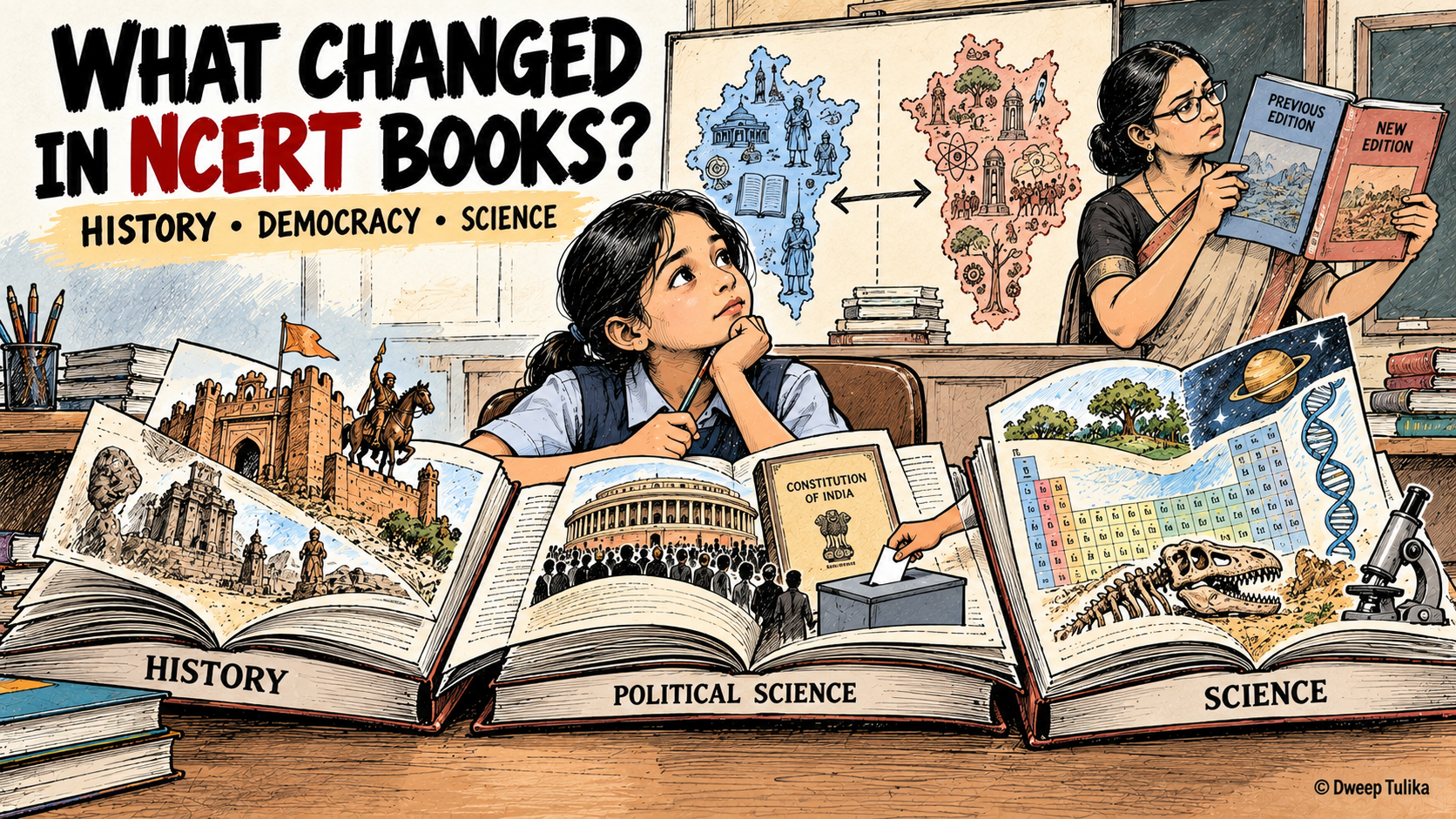
India’s school textbooks are changing—not only in their structure and presentation, but also in the way students encounter important chapters of history, political institutions, constitutional values and scientific knowledge.
Across different NCERT editions, dedicated chapters have disappeared, historical accounts have been shortened or rewritten, and some scientific topics have been removed from particular class-level textbooks. New editions have also introduced different material and reorganised subjects under the National Education Policy (NEP) 2020 and the National Curriculum Framework for School Education.
The changes have generated a wider debate about the purpose of school education. Reducing repetition and making textbooks manageable are legitimate educational goals. But an equally important question remains: when material is removed, rewritten or shifted to another class, what opportunities do students lose to understand India’s past, its democracy and the evidence on which scientific knowledge rests?
A comparison across classes and subjects reveals the scale of the debate—and why textbook changes deserve careful scrutiny.
Class 7 History: Delhi Sultanate and Mughal Empire
One of the most discussed changes concerns the teaching of medieval Indian history.
The earlier Class 7 history textbook, Our Pasts–II, contained dedicated chapters on the Delhi Sultanate and the Mughal Empire. Students encountered different dynasties, their administration, political expansion, court culture and other developments of the medieval period.
The new Class 7 Social Science textbook, Exploring Society: India and Beyond, introduced for the 2025–26 academic session, no longer contains the earlier dedicated chapters on the Delhi Sultanate and the Mughals. The revised material gives greater attention to ancient Indian dynasties, cultural traditions, pilgrimage sites and other themes. Contemporary reporting noted that the history section in the new book’s first part focused on ancient India rather than continuing through the medieval period.
The change is more significant than a shorter list of rulers.
Medieval Indian history includes political conflict, but it also encompasses administration, agriculture, trade, architecture, literature, regional cultures and interactions between communities. Students need opportunities to examine this range of developments rather than encountering a period primarily through selected themes.
The omission of dedicated chapters from the new Class 7 book does not, by itself, prove that every aspect of medieval history has disappeared from the entire school curriculum. It does, however, raise a legitimate question about how much attention the period receives and where students are expected to learn it.
Class 12 History: Mughal courts and historical evidence
The earlier Class 12 history textbook, Themes in Indian History, Part II, included a chapter titled Kings and Chronicles: The Mughal Courts.
The chapter introduced students to Mughal court chronicles and showed how historical records can be used to investigate political power, royal authority and society. It provided an opportunity to consider how historians interpret documents rather than simply memorising names and dates.
The chapter was removed during the 2022 rationalisation exercise.
The educational concern extends beyond the amount of information students receive about one dynasty. Historical documents are evidence, and learning to interpret them is a central part of studying history. Students need opportunities to compare accounts, examine the circumstances in which records were produced and recognise that historical conclusions depend on evidence and interpretation.
When a dedicated case study disappears, teachers may have fewer opportunities to develop these skills through that particular subject. Whether students receive equivalent instruction elsewhere in the curriculum is therefore an important question.
Class 9 Social Science: Kings, goddesses and historical traditions
The revised Class 9 Social Science textbook includes accounts associated with rulers who were believed to have received swords from goddesses.
The passage refers to Annamaraja of Bastar, Kumara Kampana and Shivaji, alongside traditions involving goddesses such as Kali, Durga, Bhavani and Tulja Bhavani.
Religious traditions can be important historical evidence in their own right. They help historians understand beliefs, political legitimacy, cultural memory and the ways communities have understood their past.
However, a textbook must distinguish between a documented event, a tradition passed down through a community and a claim that can be independently verified. These categories are not interchangeable.
The central question is whether the same standards of evidence and explanation are applied consistently to all communities and traditions. Students should be encouraged to understand the significance of religious accounts without being asked to accept every traditional narrative as a verified historical event.
The purpose of history education should be neither to promote nor to dismiss a religion. It should help students ask what is known, what evidence supports it and what remains a matter of belief or interpretation.
Class 10 Political Science: Democracy beyond elections
The earlier Class 10 Political Science textbook, Democratic Politics–II, contained three chapters that played an important role in explaining democratic life:
Democracy and Diversity
Popular Struggles and Movements
Challenges to Democracy
These chapters were removed during the 2022–23 rationalisation exercise.
Their subjects went beyond the formal structure of government. They examined social divisions, collective action, citizens’ movements and the difficulties democratic systems face in practice.
Democracy is not limited to casting a vote every few years. It also involves participation, peaceful protest, public debate, the right to disagree and the ability to demand accountability from those in power.
Lessons on diversity can help students understand how societies negotiate differences involving language, religion, caste, class and identity. Lessons on social movements can show how ordinary citizens have contributed to political and social change.
Removing these dedicated chapters from a textbook reduces one structured opportunity to study those subjects. The educational question is whether the revised curriculum provides comparable depth elsewhere, not merely whether the word “democracy” continues to appear in a textbook.
Class 12 Political Science: The Emergency and the Gujarat riots
The earlier Class 12 Political Science textbook, Politics in India Since Independence, discussed important events in India’s political history, including the Emergency of 1975–77 and the 2002 Gujarat riots.
Material relating to the Gujarat riots, the Emergency and other political developments was removed or reduced during the 2022 rationalisation exercise. The changes were widely reported in 2022 and 2023.
The Emergency is a major episode in India’s democratic history. It involved restrictions on civil liberties, press censorship and the detention of political opponents. Studying it helps students understand why constitutional safeguards, freedom of expression and institutional accountability matter.
The 2002 Gujarat riots are significant for examining communal violence, the responsibilities of governments and the consequences of religious conflict. Such events are difficult subjects, but their historical significance makes careful, evidence-based teaching important.
A textbook cannot include every event in equal detail. Nevertheless, when major case studies are shortened or removed, students may have fewer opportunities to investigate the relationship between political power, fundamental rights and the protection of citizens.
Democracy becomes more meaningful when students understand both its achievements and its failures.
Class 12 Political Science: The Ayodhya dispute
The account of the Ayodhya dispute in the revised Class 12 Political Science textbook has also changed.
The earlier account discussed the Ram Janmabhoomi movement, the Rath Yatra, kar seva, the demolition of the Babri Masjid, the communal violence that followed and the political consequences of the dispute.
The revised account uses the phrase “three-domed structure” in the relevant passage where the earlier text referred to the Babri Masjid. It also reduces some of the earlier discussion and gives greater attention to the Supreme Court’s 2019 verdict.
The Court’s judgment is essential to understanding the legal outcome of the dispute. But the judgment did not occur in isolation. The political movement, the demolition, the violence that followed and the debate over secularism are also part of the historical context.
When the account of a major event is shortened, the sequence of developments and the experiences of different communities may receive less attention.
Students should be able to study the legal outcome alongside the historical events that led to it. A balanced textbook should neither ignore the judgment nor allow the judgment to replace the wider history of the dispute.
Class 11 Political Science: Secularism, minority rights and vote-bank politics
Changes in the discussion of secularism and electoral politics have also attracted attention.
The revised Class 11 Political Theory material introduces the phrase “minority appeasement” in a discussion of political parties and electoral strategies. This has raised questions about how political concepts are presented to students.
There is an important distinction between protecting minority rights, ensuring equal citizenship, addressing historical disadvantages and using communities as electoral constituencies. These are related to politics, but they are not the same thing.
Constitutional protections for religious and cultural minorities are part of India’s constitutional framework. At the same time, political promises and policies can legitimately be examined for fairness, effectiveness and electoral motivation.
Students should learn to evaluate such claims through evidence and reasoned argument rather than treating a politically charged phrase as a complete explanation.
Secularism concerns the relationship between the state, religion and equal citizenship. A sound political education should help students understand the constitutional principles involved, the debates over how they are applied and the differences between competing political arguments.
Class 9 Social Science: The Preamble, socialism and secularism
The revised Class 9 Social Science textbook has generated debate over the presentation of the Constitution’s Preamble and the terms “socialist” and “secular”.
Reports in June 2026 noted that the new textbook no longer presented the Preamble and these concepts in the same way as the earlier material. NCERT sources subsequently argued that reports describing the concepts as removed were misleading, explaining that constitutional content had been reorganised and redistributed across grades under the revised curriculum.
This distinction matters. A concept being absent from a particular chapter or presented differently in one textbook is not the same as its disappearance from the entire curriculum.
Nevertheless, where and how constitutional values are taught matters. Students should understand the Preamble’s commitments to justice, liberty, equality and fraternity. They should also learn the constitutional meaning of socialism and secularism and how these concepts relate to social justice, religious freedom and equal citizenship.
These are not merely words to memorise for an examination. They help students understand real-life questions involving discrimination, poverty, religious freedom, equal opportunity and the relationship between the individual and the state.
The relevant question is whether the revised curriculum gives students a clear and age-appropriate understanding of these values, regardless of the class or chapter in which they are taught.
Class 10 Science: Evolution and heredity
The earlier Class 10 Science textbook included a chapter titled Heredity and Evolution. In the rationalised edition, the chapter title became Heredity, and substantial material on evolution was removed from that class-level textbook.
The deleted material included discussion of Darwin, speciation, fossils and human evolution.
Evolution is a foundational concept in modern biology. It helps explain how populations change over generations, how species are related and how scientists interpret evidence from fossils, genetics and biodiversity.
The distinction between removing material from a particular class and removing it from all education is important. The 2022–23 changes concerned the rationalised textbook and syllabus, and the claim should not be read as proof that evolution disappeared from every NCERT or higher-level science course.
The educational question is whether students receive sufficient exposure to foundational scientific ideas at the right stage. Students need to understand not only scientific terminology but also how scientists build explanations from evidence, test hypotheses and revise their understanding.
A strong science curriculum should allow students to connect heredity, fossils, biodiversity and the history of life through a coherent explanation of the natural world.
Class 10 Science: The periodic table
The periodic classification of elements was also removed from the rationalised Class 10 Science textbook.
The stated approach was that the topic would be covered in greater detail in Classes 11 and 12. The change therefore concerned its place in the school curriculum, not the disappearance of the periodic table from chemistry education altogether.
The periodic table is fundamental to chemistry. It organises elements and helps students understand recurring patterns in their properties, chemical reactions and the structure of matter.
Moving a topic to a higher class may be a reasonable curricular decision if students receive the necessary foundation at the appropriate stage. But the transition also raises a practical question: do students have enough prior knowledge to make sense of more advanced chemistry when they encounter it later?
Reducing repetition can be useful. The challenge is to reduce unnecessary content without weakening the conceptual foundation students need for future learning.
Class 6 Social Science: The Harappan civilisation and the term “Sindhu-Sarasvati”
Changes in the presentation of ancient Indian history have also attracted discussion.
The revised Class 6 Social Science material uses the term “Sindhu-Sarasvati” when discussing the Harappan civilisation and gives attention to the Sarasvati river.
The Harappan civilisation is studied through archaeological evidence, including settlements, artefacts, trade networks and material remains. Questions about ancient river courses and their relationship to settlements require careful treatment because some aspects remain subjects of historical and scientific investigation.
Introducing a new term or interpretation is not automatically a problem. The educational standard should be the evidence behind it and the clarity with which uncertainty is explained.
Students should be able to distinguish between archaeological findings, scholarly hypotheses and claims that remain disputed. This is particularly important when historical interpretations intersect with modern cultural or political debates.
A good textbook should help students understand what researchers know, how they know it and where further investigation is needed.
Class 8 Social Science: The judiciary textbook controversy
A separate controversy in 2026 highlighted the difficulties involved in writing about constitutional institutions.
NCERT’s Class 8 Social Science textbook, Exploring Society: India and Beyond, Part II, included a chapter titled The Role of Judiciary in our Society. One section discussed corruption in the judiciary, case backlogs and other challenges.
The chapter drew strong objections and the Supreme Court took suo motu cognisance of the matter. NCERT subsequently issued an unconditional apology and withdrew the book. A revised edition was released in July 2026 with substantial changes to the judiciary chapter, including the removal of the disputed discussion of corruption and judicial backlog and the addition or expansion of other material on the judiciary’s constitutional role, public interest litigation, tribunals and alternative dispute resolution.
This episode differs from the earlier textbook rationalisation exercise: it involved a specific controversy, withdrawal and a subsequent rewrite.
It nevertheless raises a wider educational question. Students should learn both the importance of independent constitutional institutions and the principles of accountability that apply to public institutions. Criticism should be evidence-based and appropriately contextualised; equally, students should have opportunities to understand institutional challenges and the role of reform.
The challenge is to teach complex subjects accurately, responsibly and without sweeping generalisations.
What do these changes mean for students?
Taken together, the changes raise several questions about the breadth and depth of school education.
History needs context. Students should learn about political rulers and battles, but also about ordinary people, economic developments, cultural exchange and the consequences of political decisions.
Democracy needs more than elections. Understanding democratic life requires attention to civil liberties, social movements, diversity, peaceful protest and public accountability.
Equality needs consistent explanation. Students should understand individual rights, minority protections and equal citizenship, as well as the difference between constitutional principles and political claims.
Constitutional values need clarity. The Preamble and the ideas of justice, liberty, equality and fraternity help students connect constitutional language with everyday life.
Science needs evidence and continuity. Curriculum changes should ensure that students develop a coherent understanding of foundational concepts rather than encountering disconnected facts.
These goals do not require every textbook to include every topic. They do require careful decisions about what is removed, what is retained and where essential knowledge will be taught.
Is the rationale simply to reduce the burden on students?
NCERT and the government have explained curriculum rationalisation and textbook redesign in terms of reducing content overload, avoiding duplication, improving the learning experience and aligning textbooks with the National Education Policy 2020 and the National Curriculum Framework for School Education.
These are legitimate educational objectives. A textbook that is too crowded can encourage rote memorisation rather than understanding, and some topics can be reorganised across different classes.
However, the educational value of a revision cannot be judged solely by the stated objective of reducing content. It also depends on the material selected for removal, the subjects given greater prominence, the accuracy of new passages and the opportunities students retain to study important ideas in depth.
The pattern of changes has led critics to question whether ideological priorities have influenced curriculum decisions. Establishing the motive behind each individual revision requires evidence beyond the fact that a passage has been deleted. It requires examining the selection process, the new material, the treatment of comparable subjects and the explanations offered by those responsible.
The educational consequences can—and should—be assessed directly, even where motive remains disputed.
Education should develop independent thinkers
A school textbook should do more than tell students what to remember. It should help them understand how knowledge is created, how evidence is evaluated and how different interpretations can be assessed fairly.
India’s history includes ancient kingdoms, medieval empires, religious traditions, social reform movements, struggles for independence and the development of a democratic republic. Its science education must prepare students to understand the natural world through observation, evidence and reason.
No single textbook can cover everything. Some reduction and redistribution of content will always be necessary. But decisions about what to remove should follow clear educational principles and preserve opportunities to understand historically significant events, constitutional values and foundational scientific ideas.
Students deserve to learn about the achievements and failures of governments, the contributions and conflicts of different communities, the strengths and weaknesses of democratic institutions and the evidence behind scientific knowledge.
The central question is not whether textbooks should change. It is whether those changes help students understand India more completely—or leave important parts of its history, constitutional values and scientific knowledge unexplored.
That is a question educators, parents and citizens should continue to ask.