
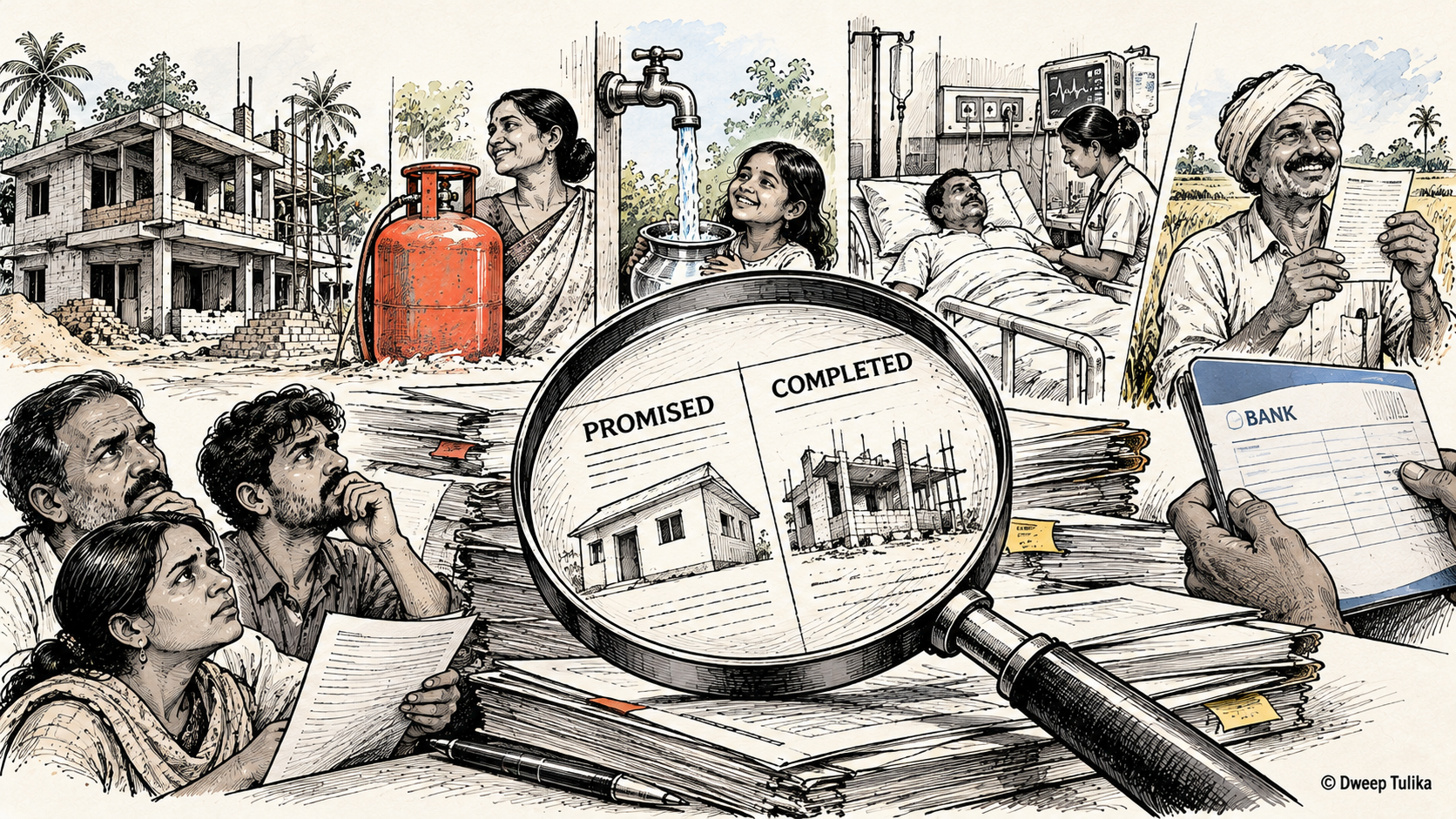
THE HEADLINE PRIME MINISTER | PART 2 OF 7
Six flagship schemes, millions of claimed beneficiaries, and the difference between receiving a benefit and experiencing lasting change.
By Dweep Tulika | Investigative Editorial
Introduction: Counting beneficiaries is only the beginning
Governments are often judged by the number of people their welfare programmes reach. Under Prime Minister Narendra Modi, schemes covering housing, cooking fuel, drinking water, healthcare, agricultural assistance and banking have become central to the Union government's development narrative.
The numbers are substantial. Crores of bank accounts have been opened, LPG connections distributed, houses sanctioned, farmers paid and households provided with tap-water connections. Ayushman Bharat has financed millions of hospital admissions.
These achievements matter. Access to a bank account, a safe home, clean cooking fuel, drinking water or hospital treatment can make a real difference to a household.
But an important question remains: How many people received the benefit they were promised, how effectively could they use it, and what changed in their lives as a result?
A house sanctioned is not necessarily a house completed. An LPG connection does not guarantee that a family can afford regular refills. A farmer receiving ₹6,000 a year may gain meaningful support, but the payment alone does not establish whether the family's income has increased. A health-insurance card does not prove that its holder has received treatment.
In this second instalment of The Headline Prime Minister, Dweep Tulika examines six flagship schemes using official figures, audit findings and published assessments. The aim is to distinguish documented delivery from broader claims about impact.
1. Pradhan Mantri Awas Yojana: Houses sanctioned versus houses completed
The Pradhan Mantri Awas Yojana (PMAY) aims to improve access to permanent housing for eligible households. It has separate rural and urban components, which must be assessed independently.
Rural housing
In an update dated 7 August 2026, the Ministry of Rural Development reported that, against a cumulative target of 4.18 crore houses under PMAY-Gramin, 3.91 crore had been sanctioned and 3.12 crore completed as of 3 August 2026. The remaining 79 lakh sanctioned houses were under construction.
These figures provide a useful distinction between approval and delivery.
Calculated from the reported figures:
- Houses sanctioned represented approximately 93.5% of the 4.18-crore target.
- Houses completed represented approximately 74.6% of that target.
- Approximately 79 lakh sanctioned houses remained under construction.
The completion figure is substantial, but it also means that the full target had not yet been completed by the reporting date. Houses under construction cannot be counted as completed homes.
Urban housing
The earlier Pradhan Mantri Awas Yojana–Urban programme had sanctioned 118.64 lakh houses by 22 July 2024. Of these, 114.33 lakh had been grounded for construction and 85.04 lakh completed or delivered, according to the Ministry of Housing and Urban Affairs.
The government subsequently introduced PMAY-U 2.0, a separate phase intended to assist one crore urban poor and middle-class families. Its dashboard reported 18.78 lakh houses sanctioned when checked for this investigation. That figure should not be added to the earlier programme's figures without accounting for the separate phases and their reporting dates.
What does this mean for households?
The number of completed houses is more informative than the number sanctioned, but completion is not the final measure of success.
A full assessment must examine whether the intended beneficiary occupies the house, whether it has adequate sanitation, electricity and drinking water, whether construction costs exceed the assistance provided, and whether eligible households were excluded or faced delays.
The scheme also operates through state and Union Territory administrations. Implementation outcomes therefore cannot be attributed to the Union government alone without examining the respective responsibilities of the Centre and the states.
Finding: Official figures demonstrate substantial rural housing delivery. They also show a gap between houses sanctioned and houses completed. Occupancy, housing quality, exclusions and affordability require further scrutiny.
Sources: Ministry of Rural Development — PMAY-G progress, August 2026; Ministry of Housing and Urban Affairs — PMAY-U 2.0 dashboard.
2. Pradhan Mantri Ujjwala Yojana: Access to LPG, but can families afford to use it?
The Pradhan Mantri Ujjwala Yojana (PMUY), launched in May 2016, provides deposit-free LPG connections to eligible adult women from poor households. Its stated purpose includes reducing reliance on traditional cooking fuels and improving access to cleaner cooking.
The government reported approximately 10.51 crore Ujjwala connections as of 1 February 2026.
That represents a large expansion of access. But connections alone do not establish how consistently households use LPG.
What do the refill figures show?
The Union government's own figures show that average per-consumer LPG refill consumption among Ujjwala beneficiaries rose from approximately three refills in 2019–20 to 4.47 in 2024–25.
The government has also continued targeted subsidies for eligible Ujjwala consumers. For 2025–26, the Union Cabinet approved a subsidy of ₹300 per 14.2-kg cylinder for up to nine refills per year, subject to the scheme's terms.
These figures matter because affordability can influence whether a household continues using LPG or returns to traditional fuels.
An average of 4.47 refills a year indicates regular use at some level, but it does not tell us how many households use LPG for all their cooking needs, how many refill less frequently, or how many rely on multiple fuels.
The Comptroller and Auditor General's 2019 performance audit found average annual refill consumption of 3.21 cylinders among Ujjwala consumers as of December 2018. It also identified implementation and monitoring issues during the period examined. Those findings are historical; they should not be presented as the scheme's current performance.
Who benefits, and what remains uncertain?
Households gaining access to LPG may benefit through reduced exposure to smoke from traditional cooking fuels and greater convenience. However, the extent of the health benefit depends partly on sustained use.
A stronger assessment would require household-level data on refill frequency, affordability, use of traditional fuels alongside LPG, and differences between income groups and regions.
Finding: The expansion of LPG connections is documented, and reported average refill consumption has increased. The number of connections alone, however, cannot establish universal or sustained clean-cooking use.
Sources: Prime Minister's Office — Ujjwala subsidy and consumption figures; CAG — Performance Audit of PMUY.
3. Jal Jeevan Mission: A tap connection is not the same as reliable drinking water
Launched in August 2019, the Jal Jeevan Mission aims to provide rural households with functional tap-water connections supplying adequate quantities of prescribed-quality water on a regular and long-term basis.
According to the Ministry of Jal Shakti, approximately 3.23 crore rural households, or 16.7%, had tap-water connections at the mission's start. By 3 March 2026, states and Union Territories reported approximately 15.82 crore connected households out of around 19.36 crore rural households, equivalent to 81.71%.
This is a substantial reported expansion of household tap-water access.
However, the connection count must be considered alongside evidence on functionality and service quality.
What did the functionality assessment find?
The government's 2024 independent functionality assessment covered 2,37,608 households in 19,812 villages across 761 districts and 34 states and Union Territories. In the surveyed villages:
- 98.1% of households had a reported tap connection available.
- 86.5% had working tap connections.
- 80.2% received water in adequate quantities.
- 83.6% received water regularly according to the applicable supply schedule.
- 76% received water meeting prescribed quality standards.
These figures describe different aspects of service delivery and should not be treated as interchangeable. The assessment covered surveyed villages, including those reported as having achieved Har Ghar Jal status; its results should not automatically be applied to every rural household in India.
The findings demonstrate why counting connections is insufficient. A household may have a tap but experience interruptions, inadequate supply or water-quality problems.
The CAG's performance audit of Jal Jeevan Mission in Karnataka, covering 2019–20 to 2023–24 and selected districts, also examined planning, finances, implementation, water quality and monitoring. Its findings provide grounds for examining implementation in the areas audited, not for declaring the entire national programme a failure.
Who benefits?
Households with reliable access to safe water can spend less time collecting water and may gain health and convenience benefits. These gains can be especially significant where collection duties fall heavily on women and children.
To determine the extent of those benefits, further evidence is needed on supply duration, water quality, repairs, seasonal shortages, local maintenance and differences between states and districts.
Finding: Reported tap-water coverage increased substantially. The government's own functionality assessment shows that connection availability, working connections, adequate quantity, regular supply and prescribed quality are distinct measures of success.
Sources: Ministry of Jal Shakti — implementation status, March 2026; Jal Jeevan Mission — Functionality Assessment 2024; CAG — Jal Jeevan Mission audit.
4. Ayushman Bharat: Health cards, hospital admissions and actual financial protection
Ayushman Bharat–Pradhan Mantri Jan Arogya Yojana (AB-PMJAY) provides eligible families with cashless hospitalisation cover of up to ₹5 lakh per family per year for specified secondary and tertiary care.
The scheme was launched in September 2018 and subsequently expanded, including to senior citizens aged 70 and above, irrespective of socioeconomic status, under the applicable scheme provisions.
By 21 September 2026, the government reported that more than 48.51 crore people held Ayushman cards. By 31 August 2026, approximately 13.25 crore hospital admissions worth ₹2.03 lakh crore had been recorded under the scheme.
These figures demonstrate extensive enrolment and substantial use of publicly funded hospitalisation coverage.
Why are cards and admissions different measures?
A card represents recorded coverage or eligibility under the programme. A hospital admission represents a service event. Neither figure alone tells us how many unique individuals received treatment, whether every patient obtained timely and appropriate care, or how much financial hardship was avoided.
The scheme's purpose is to protect eligible households from large hospital bills. Its impact should therefore be measured through successful access to treatment, patient outcomes, out-of-pocket expenditure, denied or delayed care, and access to participating hospitals.
What did the CAG find?
The CAG's 2023 performance audit examined AB-PMJAY implementation between September 2018 and March 2021. According to National Health Authority records cited in the audit, 7.87 crore beneficiary households had been registered by November 2022 against the original target of 10.74 crore households—approximately 73% of that historical target.
The target and beneficiary base subsequently changed, including an expansion approved in 2022. The audit's registration figure must therefore be understood in its original context, not treated as the current national coverage rate.
The audit examined beneficiary identification, implementation, claims, monitoring and other aspects of scheme administration. Its findings warrant scrutiny of the specific weaknesses identified; they do not negate the hospitalisation benefits received by eligible patients.
Who benefits, and who might still face barriers?
Eligible patients who receive cashless hospital treatment can gain meaningful financial protection. However, access may depend on awareness, hospital availability, the procedures covered, the participating provider network and the ability to navigate the system.
A complete assessment must distinguish coverage from treatment and authorised expenditure from a direct estimate of money saved by households.
Finding: Official figures demonstrate extensive enrolment and hospitalisation activity. The actual degree of financial protection requires additional evidence on treatment access, patient experience and out-of-pocket spending.
Sources: PIB — Ayushman Bharat progress, September 2026; CAG — Performance Audit of AB-PMJAY.
5. PM-KISAN: Direct support for landholding farmers, but is it enough?
The Pradhan Mantri Kisan Samman Nidhi (PM-KISAN), operational from December 2018, provides eligible landholding farmer families with ₹6,000 annually in three equal instalments, transferred directly to bank accounts.
On 20 June 2026, the government released the 23rd instalment. The official announcement reported that more than ₹18,880 crore would be transferred to over 9.44 crore farmers. A subsequent government summary reported more than 9.49 crore farmers benefiting under that instalment, with over ₹18,984 crore released.
These are instalment-specific figures and should not be confused with the cumulative number of distinct farmers who have benefited since the scheme began.
What does ₹6,000 a year mean for a household?
The transfer provides direct financial assistance that can help eligible farmers meet agricultural or household expenses. Its usefulness depends on the household's circumstances, the timing of payments and the costs it faces.
However, the annual amount is not designed to replace farm income, guarantee a minimum income or cover all cultivation costs. Its impact must be assessed alongside expenditure on seeds, fertilisers, irrigation, labour, debt repayments and household needs.
Who is covered—and who may be excluded?
PM-KISAN is based on eligible landholding farmer families, subject to exclusions. State and Union Territory administrations identify beneficiaries according to scheme rules, and land records play an important role in establishing eligibility.
This means that tenant cultivators and agricultural labourers who do not meet the landholding criteria may not qualify simply because they depend on agriculture for their livelihoods. People whose land records are outdated or disputed may also face administrative barriers.
The scheme's official portal notes that eKYC is mandatory and that suspected ineligible or duplicate-family claims may be withheld pending verification.
The central question is therefore not merely how much money has been transferred, but how many eligible farming households receive payments regularly, how many are excluded by the eligibility rules or record systems, and how much the assistance changes their financial position.
Finding: PM-KISAN provides direct cash support to millions of eligible landholding farmer families. Its coverage does not automatically extend to every person who works in agriculture, and the transfer amount alone cannot establish the scheme's effect on farm incomes or indebtedness.
Sources: PM-KISAN official portal; PIB — 23rd instalment announcement, June 2026.
6. Jan Dhan: Banking access is not the same as financial security
The Pradhan Mantri Jan Dhan Yojana was launched in August 2014 to expand access to basic bank accounts and related financial services.
The official dashboard reported 59.49 crore accounts and approximately ₹3.20 lakh crore in deposits as of 30 September 2026. It also reported 33.18 crore female account holders and 41.70 crore RuPay debit cards issued.
These are significant indicators of the expansion of formal banking access. Accounts can help people receive welfare transfers, make payments and access other financial services.
However, the total number of accounts is not necessarily the number of unique people who became financially included for the first time. Nor does account ownership establish that the account is regularly used or that its holder has access to affordable credit, insurance or adequate savings.
The number of debit cards issued is also different from the number actively used. Deposits across accounts do not reveal how evenly balances are distributed among account holders.
A fuller assessment would examine account activity, first-time access to banking, receipt of direct benefit transfers, access to insurance and credit, and changes in household financial resilience.
Finding: Jan Dhan has expanded formal banking access on a substantial scale. The extent to which that access has produced lasting improvements in financial security requires additional evidence.
Source: Department of Financial Services — official PMJDY dashboard.
7. Who benefited most? What can we calculate today?
The six schemes serve different populations and provide different types of assistance. Their beneficiary figures cannot simply be added together to calculate the number of Indians who benefited from government welfare.
One household may receive foodgrain, LPG assistance, housing support, a bank transfer and healthcare coverage. Counting each benefit as a separate person would inflate the total number of beneficiaries.
A responsible calculation requires a defined population, a consistent reporting date and a clear measure of what counts as a benefit.
| Scheme | What the published data measures | What it does not establish by itself |
|---|---|---|
| PM Awas Yojana | Houses sanctioned and completed | Unique households with adequate, occupied housing |
| Ujjwala | LPG connections and average refill consumption | Households using LPG consistently for all cooking |
| Jal Jeevan Mission | Reported connections and functionality indicators | Every household receiving reliable, safe water throughout the year |
| Ayushman Bharat | Cards, hospital admissions and authorised expenditure | Unique patients receiving effective care and the exact amount each household saved |
| PM-KISAN | Eligible farmer families and instalment transfers | All agricultural workers covered or the resulting change in farm income |
| Jan Dhan | Accounts, deposits and debit cards issued | Unique first-time banking users or improved financial security |
This is why a single percentage claiming to represent the share of Indian society that benefited from all six schemes would be misleading without a reliable, unduplicated household-level dataset.
The appropriate next step is to calculate coverage separately for each scheme, compare the eligible population with actual delivery, and examine the distribution of benefits by state, rural or urban location, gender and income group wherever data permits.
8. The public money behind welfare
The scale of a programme must also be examined alongside its cost.
The investigation will distinguish budget allocations from actual expenditure, money released to states from money spent on beneficiaries, and expenditure from measurable results.
For programmes involving state-level implementation, the respective contributions of the Union government and state governments must be documented. Delays, administrative failures or successful outcomes may arise at different levels of government.
Independent audits are particularly useful because they examine financial management, compliance, monitoring and implementation. Their findings must be read within the audit's period and scope, and not generalised beyond the evidence.
The objective is to determine not simply how much money was allocated, but what the public received in return and whether resources reached the intended beneficiaries efficiently.
Conclusion: Millions reached, but how much changed?
The evidence reviewed in this article shows that major welfare schemes have expanded access to banking, housing assistance, LPG, drinking water, healthcare and direct agricultural support.
There are measurable achievements: substantial numbers of rural houses have been completed, LPG connections have expanded, reported tap-water coverage has increased, Ayushman Bharat has financed millions of hospital admissions, PM-KISAN has transferred financial assistance to eligible farmer families, and Jan Dhan has brought formal bank accounts within reach of millions.
The evidence also shows why headline numbers need context. Sanctions are not completions. Connections are not necessarily sustained use. Registrations are not treatment. Cash transfers are not a complete measure of farm income. And bank accounts do not automatically translate into financial security.
These distinctions do not erase the benefits received by households. They establish the questions that must be answered before the scale of those benefits can be measured accurately.
The next stage of this investigation will examine differences between states, communities, income groups and rural and urban households. It will also investigate exclusions, service quality, implementation costs and the extent to which the reported benefits can be attributed to particular policies.
For now, the evidence supports neither a blanket dismissal of welfare achievements nor the assumption that every announced beneficiary experienced the full intended benefit.
The question is not only how many people were reached. It is how many received the promised service, how well it worked, and how much it improved their lives.
The Headline Prime Minister will continue to examine these questions through documented evidence, transparent calculations and scrutiny of both government claims and criticism.
Series: The Headline Prime Minister | Part 2 of 7 | Dweep Tulika Editorial