
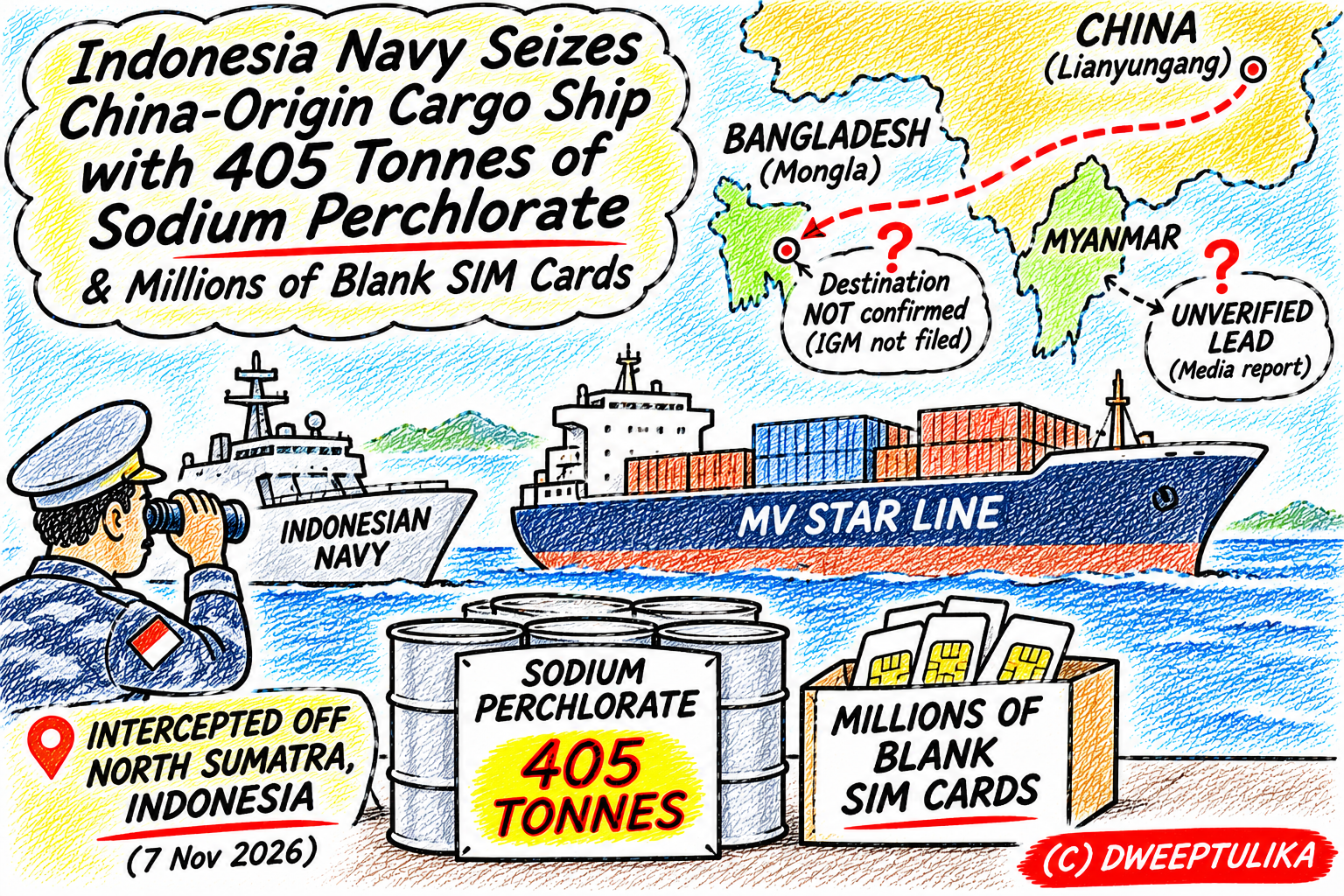
A major maritime interception by the Indonesian Navy has raised questions about the movement of strategic industrial chemicals, suspicious shipping operations and possible cross-border supply networks in Southeast Asia. Authorities seized a foreign cargo vessel carrying approximately 405 tonnes of sodium perchlorate along with millions of blank 4G SIM cards.
The vessel, identified as MV Star Line and flying the flag of Comoros, was intercepted in waters off Belawan in North Sumatra, Indonesia, on November 7. According to media reports, the vessel had departed from Lianyungang Port in China and was reportedly scheduled to reach Mongla Port in Bangladesh.
The Indonesian Navy publicly disclosed the seizure on November 20 during a press briefing at the headquarters of Naval Regional Command I in Belawan. The operation was conducted by the Indonesian Navy patrol vessel KRI Sigalu-857.
The seizure has raised questions about the vessel's documentation, registration status, cargo declarations and the identity of those responsible for the shipment. The ownership of the consignment and its ultimate recipient have not yet been publicly established.
Suspicious movements led to interception
According to the Indonesian Navy, MV Star Line came under suspicion after maritime monitoring systems detected unusual movements in the waters off Belawan.
The vessel reportedly failed to respond to radio communications from the Indonesian patrol unit. Its movements and an apparent unscheduled stop in the area, reportedly for refuelling, prompted further investigation.
Following the interception, authorities inspected the vessel's 36 containers. Fifteen containers were found to contain approximately 405 tonnes of sodium perchlorate. Investigators also recovered millions of blank 4G LTE SIM cards stored across 54 pallets.
The vessel was subsequently secured for further examination. The investigation involves multiple Indonesian agencies, including the Navy, National Police, National Narcotics Agency, Customs and Immigration authorities.
The Indonesian Navy also reported irregularities in the vessel's administrative and registration documentation, including a reportedly suspended registration status. Questions surrounding the validity of its shipping documents and compliance with regulations governing the transportation of dangerous goods are also being examined.
What is sodium perchlorate and why is the quantity significant?
One of the most important aspects of the seizure is the discovery of 405 tonnes of sodium perchlorate.
Sodium perchlorate is a strong oxidising chemical used in several industrial and specialised applications. It has particular significance in the manufacture of certain rocket and missile propellants, where it can serve as an oxidising component.
However, sodium perchlorate is not itself an explosive device or finished missile fuel. Its potential use depends on the manufacturing process and combination with other materials.
The quantity recovered is substantial and has attracted attention because of the chemical's strategic applications. Indonesian naval officials have reportedly stated that the quantity could potentially be used in the production of up to 100 missiles.
Nevertheless, authorities have not publicly established that the consignment was intended for military production or any particular armed group. Its declared commercial purpose, ownership and ultimate recipient remain matters requiring investigation.
Why was the vessel reportedly heading to Bangladesh?
The reported China-to-Bangladesh route has become another important part of the story.
Shipping information cited by international media and vessel-tracking platforms identified Mongla Port in Bangladesh as the intended destination of MV Star Line. The vessel was reportedly scheduled to arrive there on November 8, a day after its interception.
However, questions have emerged over whether the reported destination was formally declared to Bangladeshi customs authorities.
Reports published in Bangladesh on November 24 quoted Mongla Customs officials as saying that their office had no information about the vessel and that no Import General Manifest (IGM) had been filed on the relevant customs system.
An Import General Manifest is an important shipping document containing details of a vessel's cargo and the parties associated with its importation. Its reported absence raises questions about whether the destination had been formally declared through the corresponding customs documentation.
The absence of an IGM does not by itself establish that the vessel was never intended to reach Bangladesh. However, the reported destination has not yet been supported by the corresponding customs documentation.
The Indonesian Navy's official announcement identified the interception location and cargo but did not independently establish the identity of the importer or ultimate recipient.
The identity of the importer, cargo owner and local shipping agent has not yet been publicly established.
Possible Myanmar connection: An investigative lead, not a confirmed finding
An additional dimension emerged through a report published by Northeast News on November 23.
The report, citing its inquiries into the matter, claimed that Bangladeshi security investigators were examining a possible connection between the seized consignment and an armed group operating in Myanmar.
According to the report, investigators suspected that the chemical and SIM cards could have been intended for a Myanmar-based insurgent network, with the possibility that the cargo might have been transferred through Bangladesh using smaller vessels.
The report also claimed that an individual of Myanmar origin had been identified in connection with the consignment.
These allegations, however, have not been independently established through a publicly released investigation report or official confirmation from the Indonesian Navy or Bangladeshi authorities.
No specific insurgent organisation has been officially identified as the intended recipient. Nor has any authority publicly confirmed that the seized material was meant to be transferred into Myanmar.
Consequently, the alleged Myanmar connection must be treated as an investigative lead reported by one media outlet, rather than an established fact.
Was the vessel intercepted near the Andaman Islands?
The location of the interception is important, particularly given the geographical significance of the wider region.
The Indonesian Navy's announcement places the interception in waters off Belawan, North Sumatra. This is on the northeastern/eastern coast of Sumatra, Indonesia.
The vessel was not intercepted in the Andaman Sea or near the Andaman and Nicobar Islands.
The Andaman Sea lies east of the Andaman and Nicobar island chain and is bounded by Myanmar, Thailand, the islands and the northern coast of Sumatra. The recognised southern boundary of the Andaman Sea runs along the northern coast of Sumatra towards its northern tip. Belawan lies outside this defined sea area.
The incident is therefore not a direct maritime interception in the waters surrounding the Andaman Islands. Its regional relevance arises from the reported Bangladesh destination and the possibility of a wider Southeast Asian shipping connection.
For India, developments involving maritime routes across Southeast Asia and the Bay of Bengal remain relevant because of the strategic position of the Andaman and Nicobar Islands. However, there is currently no publicly verified evidence connecting MV Star Line to Indian waters, an attempted entry into the Andaman and Nicobar Islands, or a direct security threat to the Islands.
The unanswered questions
The Indonesian Navy's seizure has established the presence of a large quantity of sodium perchlorate and millions of blank SIM cards aboard a foreign-flagged vessel. But several important questions remain unanswered:
Who owned the 405 tonnes of sodium perchlorate?
Who arranged and financed the shipment?
Why was the vessel carrying millions of blank SIM cards alongside the chemical consignment?
Was Mongla Port genuinely the intended destination, given the reported absence of an Import General Manifest?
Who was supposed to receive the cargo?
Was there any intended onward movement of the material into Myanmar?
Why did the vessel's registration and shipping documents reportedly show irregularities?
These questions will require answers from the ongoing investigations and the relevant maritime, customs and security authorities.
Investigation continues
The Indonesian Navy has confirmed that the seized vessel and its cargo have been secured for further investigation, with multiple agencies involved in examining the circumstances surrounding the interception.
At present, the confirmed facts establish a significant seizure of a strategic industrial chemical and a large quantity of blank SIM cards from a foreign cargo vessel operating in Indonesian waters.
The reported China-to-Bangladesh route, questions over customs documentation and the alleged Myanmar connection have added further layers to the case. However, the identity of the ultimate recipient and the intended purpose of the consignment remain unresolved.
For the wider Bay of Bengal region, the incident highlights the importance of monitoring sensitive chemical shipments, cargo declarations, vessel ownership, registration records and the networks operating behind international commercial shipments.
Until the investigation establishes who was supposed to receive the consignment and why, the most significant question surrounding MV Star Line remains unanswered: where was the 405-tonne chemical shipment ultimately intended to go?
This report draws on the Indonesian Navy's announcement and reporting by Bangladeshi and international media. Allegations concerning a possible Myanmar connection remain unverified.