
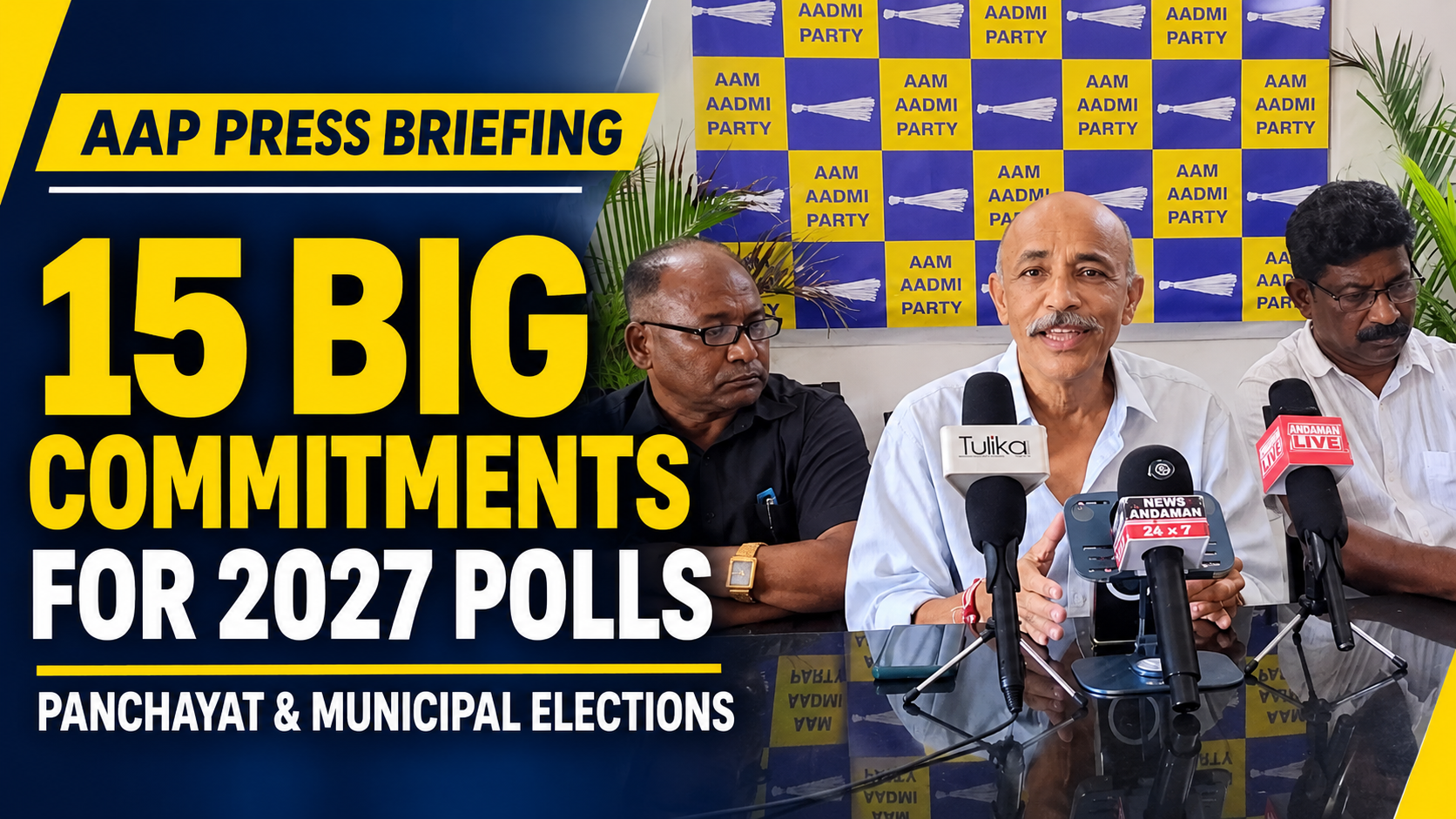
The Aam Aadmi Party (AAP) has announced a 15-point agenda for its proposed candidates in the 2027 local body elections in the Andaman and Nicobar Islands. Party State President Dr. Arun K. Mallik said AAP intends to contest municipal and panchayat seats with a focus on improving basic public services and addressing local civic issues.
Addressing a press briefing on November 14, Dr. Mallik said the party had received approval from its national leadership to field candidates in the forthcoming local body elections. He said AAP would offer tickets to young and educated candidates and described the party's approach as an alternative to the existing political choices in the Islands.
The briefing covered the party's proposed commitments for municipal wards and panchayats, timelines for selected projects, additional measures for rural areas, and its position on local governance and accountability. Dr. Mallik also responded to questions from journalists after his statement.
15-point agenda for municipal wards and panchayats
Dr. Mallik said the 15 commitments would apply to both municipal wards and panchayat areas. He described them as responsibilities that AAP's elected ward councillors and panchayat heads would be expected to pursue if the party's candidates were elected.
The proposals cover healthcare, education, drinking water, cooking gas distribution, roads, public transport, electricity, public safety, communication networks, community learning facilities, stray cattle management, encroachment, illegal liquor outlets, and efforts to make wards drug-free and corruption-free.
1. Improved healthcare services
Dr. Mallik proposed establishing an Urban Health Centre in every municipal ward represented by an elected AAP councillor.
According to him, the centres would have daily doctor visits, outpatient services and basic laboratory facilities. He referred to the existing urban health infrastructure in the municipal area and argued that healthcare facilities needed further improvement.
He said the party would work towards establishing these facilities within three years of its candidates being elected.
2. Improved education facilities
The second commitment concerns improving school infrastructure and services.
Dr. Mallik said school buildings requiring repairs would be taken up, and separate toilets for boys and girls should be available in schools where these facilities were missing. He also referred to the need for qualified teachers and proper functioning of the Mid-Day Meal scheme.
He announced a timeline of one year for the education-related commitments, saying AAP councillors would take responsibility for pursuing improvements in schools falling within their respective wards.
3. Drinking water and cooking gas supply
Dr. Mallik raised concerns about the availability of drinking water despite official claims regarding household tap-water coverage.
He said AAP councillors would work towards ensuring access to clean drinking water in their respective areas within two years.
He also addressed difficulties faced by residents in obtaining cooking gas cylinders, particularly where people have to carry cylinders over long distances. He said party councillors would coordinate with the concerned gas distributors and suppliers to improve doorstep delivery and address problems in the distribution system.
4. Construction and improvement of roads
The party has proposed the construction of roads across the wards where its candidates are elected.
Dr. Mallik said the objective would not be limited to roads that can accommodate motorcycles or smaller vehicles. He said roads should also support four-wheelers and public transport wherever feasible.
He announced a three-year timeline for the road-related commitment and said the party would work with the Administration and other concerned agencies to pursue the required funding and implementation.
5. Better public transport connectivity
Dr. Mallik said public transport should reach beyond the main roads and extend into residential areas.
He acknowledged that larger buses may not be able to enter every narrow road and proposed using smaller buses through outsourcing arrangements where necessary.
He said AAP representatives would work towards improving connectivity within municipal wards and panchayat areas so that residents living away from main roads could also access public transport.
6. Improvement in power supply
On electricity, Dr. Mallik said the issue was complex and did not announce a specific implementation timeline.
However, he stated that an AAP-led ward or panchayat would work towards improving the power supply situation.
7. Streetlights and CCTV cameras for public safety
The party proposed installing streetlights and CCTV cameras at locations where they are required to improve public safety.
Dr. Mallik announced a two-year timeline for this commitment and said the measures would be taken up in the wards and panchayat areas represented by AAP candidates.
8. Better telephone and mobile network connectivity
Dr. Mallik also included access to telephone and mobile networks among the party's commitments.
He said the party would work towards improving network connectivity and providing mobile hotspots and Wi-Fi facilities in the respective areas within three years.
9. Community learning centres
Another proposal is the establishment of community learning centres.
Explaining the concept, Dr. Mallik said these centres would provide opportunities for informal learning and knowledge-sharing. He proposed facilities such as libraries and indoor gaming areas where residents could gather and learn.
10. Kanji houses for stray cattle
Addressing the issue of stray animals, particularly cattle, Dr. Mallik proposed establishing one kanji house in every municipal council area and panchayat.
He referred to complaints about stray cattle damaging agricultural fields and said the facilities would help address the problem.
The proposed timeline for establishing these facilities is three years.
11. Action against encroachment and illegal construction
Dr. Mallik said AAP councillors and panchayat heads would not support encroachment or illegal construction in their respective areas.
He referred to instances of alleged encroachment and said elected representatives should not misuse their positions to protect unauthorised activities.
He stated that the party would work towards stopping such practices and ensuring that local representatives did not become involved in illegal construction or encroachment.
12. Action against illegal liquor outlets
Dr. Mallik described illegal liquor outlets as a concern in several areas and said action against them would form part of the party's agenda.
He said the issue would require coordination between elected representatives and law-enforcement agencies, including the police.
During the briefing, he referred to allegations of possible monthly payments connected with certain illegal outlets, but explicitly stated that he did not have documented evidence to substantiate those allegations. He said that if AAP representatives were elected, they would take up the issue with the concerned authorities.
13. Drug-free wards
Dr. Mallik said AAP's objective would be to make the wards represented by its candidates drug-free.
He included this among the party's final commitments and said elected representatives would work towards addressing the problem at the local level.
14. Corruption-free wards
The party also announced a commitment to make its wards corruption-free.
Dr. Mallik said elected representatives would be expected to act against corruption and raise issues affecting residents. He repeatedly described the party's proposed approach as one based on accountability and opposition to corruption.
15. Implementation and accountability for the commitments
Dr. Mallik said the 15 commitments would form the basis of the responsibilities expected from AAP's elected councillors and panchayat heads.
He emphasised that the party was announcing timelines for several proposals and said its representatives would be answerable if the commitments were not fulfilled.
He further stated that if the party failed to meet the announced timelines, its representatives would be prepared to resign. He expressed confidence that the party would be able to implement the proposals if voters supported its candidates.
Additional commitments for rural panchayat areas
Apart from the 15 common commitments, Dr. Mallik outlined additional measures specifically for rural areas.
He said that although the broader agenda would apply to both municipal and panchayat areas, healthcare in rural locations required particular attention.
Among the additional proposals, he said:
Auxiliary Nurse Midwives (ANMs) should remain at their designated stations as required.
Doctors from the concerned Primary Health Centre should visit the Sub-Centres once a week.
Rural Primary Health Centres should have at least two doctors.
Dr. Mallik said he had observed gaps in the functioning of some Sub-Centres and referred to the need for regular medical visits and adequate staffing.
He also cited Kalighat Panchayat as an example. He said that if an AAP candidate were elected there, the party would work towards constructing a bridge in the area within three to four years. He also promised regular doctor availability at the Kalighat Primary Health Centre, action against illegal liquor outlets and visits by doctors to Sub-Centres in the area.
Dr. Mallik's remarks on local governance and political alternatives
During the briefing, Dr. Mallik repeatedly described AAP as an alternative political option for the Islands.
He referred to the party's proposed participation in the 2027 local body elections and said it intended to field candidates in municipal wards and panchayats. He also urged young and educated residents interested in public service to come forward and seek party tickets.
A significant portion of his address was devoted to criticism of the Congress and BJP, as well as other political parties. He alleged that corruption and political patronage had affected local development and accused successive political representatives of failing to address public concerns.
These were political allegations made by the AAP State President during the press briefing and were not independently established in the course of the briefing.
Dr. Mallik also referred to alleged irregularities involving public funds and mentioned a figure of ₹124 crore in connection with his remarks about the 2024 election period. He said he had raised the matter and submitted material to investigating agencies. He also referred to reports concerning other individuals and political figures.
He criticised what he described as a lack of accountability among elected representatives and said AAP would seek to identify local problems and take them up with the concerned government departments and officials.
AAP says it has opened an office in Jodakalan
Dr. Mallik said the party had opened an office in Jodakalan and encouraged residents to join AAP and participate in its activities.
He also spoke about changes in the party's local leadership, saying that he had been appointed State President on August 10. He acknowledged that the party's earlier leadership had affected public perception and sought to distinguish the present leadership from its past.
During the briefing, he referred to the support of the party's national leadership, including National Convenor Arvind Kejriwal, Sanjay Singh and party in-charge Advocate Somnath Bharti.
He also invited residents to contact the party and participate in its membership and organisational activities.
Proposed visit to North and Middle Andaman
Towards the end of his statement, Dr. Mallik announced that the party's team was planning a visit to North and Middle Andaman.
He mentioned Chouldari, Rangat, Mayabunder and Diglipur among the proposed stops and said the team intended to meet senior officials during the visit.
He explained that the party's approach would involve identifying problems faced by residents and taking them up with local officials and the departments concerned.
Dweep Tulika raises questions on functioning of existing facilities
During the question-and-answer session, Dweep Tulika's Vineeth raised questions about the implementation of the 15 commitments and the accountability of elected representatives.
Vineeth pointed out that several facilities mentioned in the party's agenda already exist, including school toilets, Mid-Day Meal services and healthcare facilities. However, the existence of a facility does not necessarily mean that it is functional, properly maintained or usable.
He asked what action AAP representatives would take if existing facilities deteriorated, remained unusable or were not maintained by the heads of institutions or the concerned authorities.
Responding to the question, Dr. Mallik acknowledged that facilities such as Sub-Centres, schools and Mid-Day Meal services exist but are not always functioning as they should.
He referred to Sub-Centres where, according to him, doctors were not making regular visits despite instructions. He said AAP's elected representatives would take up such issues with the Directorate of Health Services and the Directorate of Education through official communication and written representations supported by evidence.
He expressed confidence that the concerned officials would act when issues were formally raised with supporting material.
Question on accessibility for Children with Special Needs
Vineeth then extended the question to facilities that are still missing in schools and healthcare institutions.
He raised concerns about accessibility for Children with Special Needs (CWSN) in schools, including the availability of ramps and other necessary provisions. He also referred to ramps and designated waiting arrangements at Primary Health Centres and other health facilities.
The question further addressed accessibility in public transport, including whether staff knew how to operate the ramps provided in newer STS buses.
In response, Dr. Mallik said that guidelines and provisions already exist but are not being properly implemented. He said AAP would take up the implementation of these requirements with the concerned authorities.
He also returned to the issue of public transport, stating that smaller buses could be used in areas where larger buses cannot enter. He said the party would work towards improving transport connectivity and accessibility.
The exchange highlighted an important distinction between announcing new facilities and ensuring that existing facilities are properly maintained, functional and accessible to the people who need them.
Questions on political party classification
In another question, Vineeth sought clarification on Dr. Mallik's reference to different classifications of political parties, particularly registered but unrecognised political parties.
Dr. Mallik explained that political parties are classified by the Election Commission of India under different categories, including national parties, recognised state parties and registered unrecognised political parties.
During the exchange, he named the Andaman and Nicobar Democratic Congress and the Andaman and Nicobar Janata Party while discussing the registered unrecognised category. He clarified that the classification he was referring to was made by the Election Commission of India and not by him personally.
The discussion concluded with Dr. Mallik reiterating his position on AAP's proposed participation in the 2027 local body elections.
Full press briefing made available for public viewing
The press briefing included the party's announced commitments, its political position, allegations raised by its State President and questions from the media.
Dweep Tulika is publishing the complete press briefing recording, including the question-and-answer session, so that viewers can hear the statements and responses in their full context rather than relying only on selected excerpts.
The 15-point agenda remains a set of commitments announced by AAP ahead of the proposed 2027 local body elections. Their implementation would depend on the party's candidates being elected, the powers available to the respective local bodies, and coordination with the concerned departments and authorities.
Ultimately, voters will be able to assess the proposals, the timelines announced and the party's ability to deliver on its commitments.