
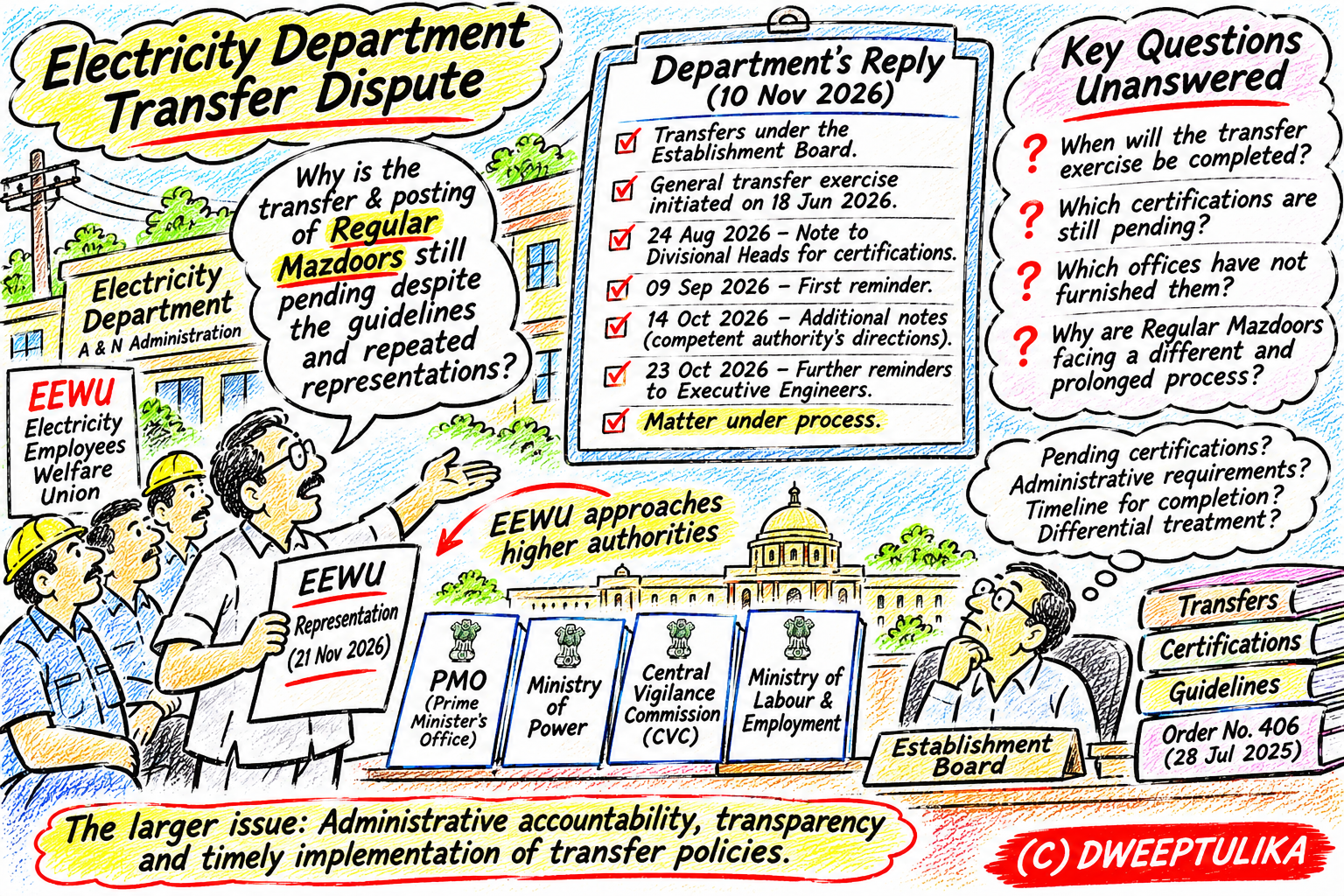
A dispute over the delayed transfer and posting of Regular Mazdoors in the Electricity Department of the Andaman and Nicobar Administration has now reached the highest levels of the Central Government, with the Electricity Employees Welfare Union (EEWU) approaching the Prime Minister's Office (PMO), Union Ministry of Power, Central Vigilance Commission (CVC) and Ministry of Labour and Employment.
In its latest representation dated November 21, 2026, the union has questioned the prolonged delay in the transfer exercise and described the Electricity Department's written reply of November 10 as unsatisfactory. EEWU has sought intervention, accountability and a time-bound decision on the pending transfers.
The dispute centres on a transfer exercise which, according to the union, was required to be completed between April 15 and June 15, 2026. However, the department's reply indicates that administrative correspondence concerning the exercise continued through October, with the matter still under process as of November 10.
EEWU maintains that the transfer exercise was required to be completed between April 15 and June 15, 2026. It argues that the existing guidelines and the 2025 order do not justify unnecessarily prolonging or complicating the process.
The union has questioned why the transfer and posting of Regular Mazdoors remain unresolved despite the prescribed framework and repeated representations.
What the Electricity Department's November 10 reply says
The written response issued by the Office of the Superintending Engineer (Electricity) outlines a series of administrative steps taken in connection with the transfer exercise.
According to the department, transfers and postings are undertaken under the supervision of the Establishment Board, taking into account administrative requirements, departmental exigencies and applicable government instructions.
The reply states that a general transfer exercise was initiated through a letter dated June 18, 2026, with the approval of the competent authority.
The subsequent administrative steps listed in the reply include:
August 24, 2026: A note was issued to the concerned Divisional Heads seeking the necessary certifications relating to the proposed transfers.
September 9, 2026: A first reminder was issued.
October 14, 2026: Additional notes were issued following directions from the competent authority.
October 23, 2026: Further reminders were issued to the concerned Executive Engineers.
The department stated that it was reiterating the requirement for the necessary certifications to facilitate the transfer exercise and that the matter was under process for further necessary action.
The reply was digitally signed by T. Jameela Bibi, Statistical Officer/Public Grievance Officer.
What remains unanswered?
While the department's reply provides a chronology of correspondence, it does not specify when the required certifications are expected to be received or when the transfer exercise will be completed.
It also does not identify the particular certifications that remain pending, the offices yet to furnish them or the specific administrative obstacles preventing a final decision.
This leaves several important questions:
If the transfer exercise was initiated in June, why were the necessary certifications still being pursued through repeated reminders in October?
Have all concerned Divisional Heads and Executive Engineers furnished the required information?
Has the Establishment Board reviewed the reasons for the continued delay?
Has any timeline been fixed for completing the exercise?
And when can the affected Regular Mazdoors expect a final decision?
The department's explanation identifies the administrative process but does not provide a clear answer on its expected conclusion.
EEWU alleges differential treatment of Regular Mazdoors
Another important issue raised in the November 21 representation concerns what EEWU describes as differential treatment of Regular Mazdoors compared with other employee categories.
The union alleges that similar additional procedural complications were not introduced during the 2026 general transfer exercise for several other categories, including Linemen, Oilmen, Electrical Fitters, Mechanical Fitters, Bill Distributors, MRLCC, MTS, LMMR, JE Drivers and Foremen.
EEWU has questioned why Regular Mazdoors appear to be facing a different and prolonged process.
If the procedures applied to these categories differ, the department should clarify the reasons and explain the criteria being followed. Whether the procedures were actually identical, however, requires verification from the Electricity Department.
Union approaches PMO, Power Ministry and CVC
Dissatisfied with the November 10 response, EEWU has now taken the matter beyond the departmental level.
Its November 21 representation has been addressed to the Prime Minister of India, the Union Minister of Power, the Director of the Central Vigilance Commission and the Union Minister of Labour and Employment.
The union has requested intervention into what it describes as an unexplained and prolonged delay and an alleged failure to comply with the prescribed transfer guidelines.
It has also sought accountability and appropriate directions for completing the transfer and posting exercise without further unnecessary delay.
The representation warns that, if the matter is not addressed within a reasonable timeframe, the union may approach the appropriate ministries and seek legal remedies before the competent court to safeguard the interests of the employees.
It is important to clarify that submitting a complaint to the CVC does not, by itself, establish that a vigilance violation has occurred or that an investigation has been initiated.
The larger question of administrative accountability
The dispute is not simply about the movement of employees between postings. It concerns the timely implementation of administrative decisions, consistency in applying transfer policies and the responsibility of authorities when official processes remain pending.
The Electricity Department has cited administrative requirements, the Establishment Board's supervision and the need for certifications from divisional authorities. Such requirements may form part of a transfer exercise.
However, the department's reply leaves the practical questions of pending documentation, responsibility and completion timelines unresolved.
If additional certifications are necessary, the department should be able to explain their purpose, identify the outstanding requirements and indicate when the process is expected to conclude.
Questions requiring answers from the Electricity Department
In the interest of transparency, Dweep Tulika seeks clarification on the following:
What is the present status of the general transfer exercise for Regular Mazdoors?
Why was the exercise initiated through the June 18 letter when the period cited by EEWU for completion was April 15 to June 15, 2026?
How many Regular Mazdoors are covered by the proposed transfer exercise, and how many transfers remain pending?
Which Divisional Heads or Executive Engineers have yet to furnish the required certifications despite the reminders issued?
What specific administrative requirements are preventing completion?
Has the Establishment Board reviewed the prolonged delay and fixed a timeline for a final decision?
Why does EEWU allege that other employee categories did not face comparable procedural complications?
Has the department examined the union's allegation concerning the implementation of Order No. 406 dated July 28, 2025?
Dweep Tulika's position
Government employees are entitled to fair, transparent and consistent administrative treatment. At the same time, departmental decisions must take operational requirements and the public interest into account.
The Electricity Department's November 10 reply has outlined the correspondence undertaken by its offices. But the central issue remains: the transfer exercise is still described as under process, without a clear completion date in the reply examined by Dweep Tulika.
With EEWU now approaching central authorities, the matter has moved beyond an internal departmental disagreement.
The administration should place the actual status of the exercise on record, explain the reasons for the delay and communicate a clear timeline for a final decision.
A process cannot be considered satisfactorily resolved simply because reminders have been issued. Ultimately, administrative accountability must be measured by decisions taken and action completed.
Dweep Tulika has examined the Electricity Department's written reply dated November 10, 2026, and EEWU's subsequent representation dated November 21, 2026.