
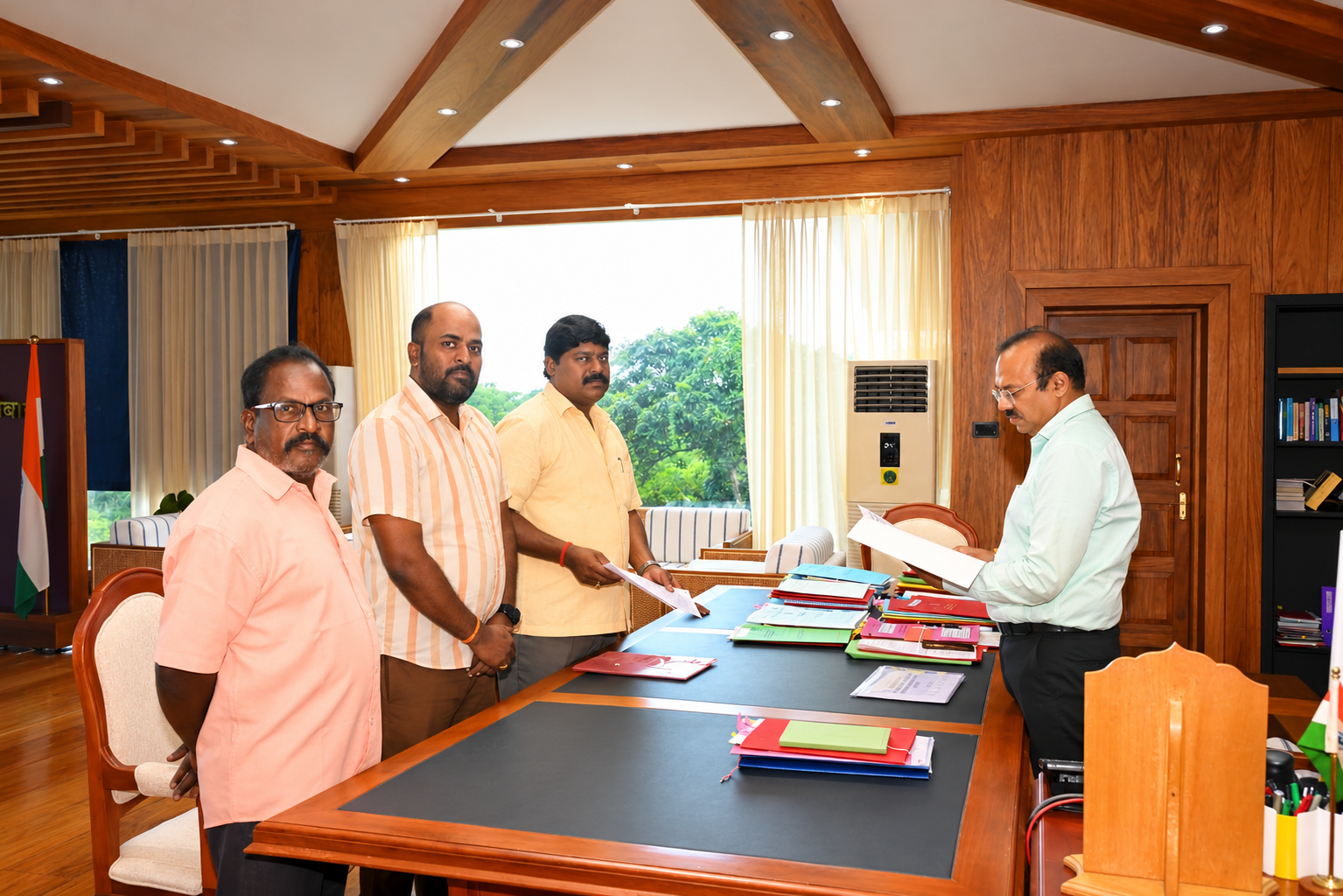
Nearly two months after placing a list of long-pending demands before the Lieutenant Governor, representatives of the Fishermen Welfare Association and the Andaman & Nicobar Fisheries Cooperative Federation Ltd. (ANIFCOFED) have approached the Chief Secretary, seeking action on issues ranging from basic fisheries infrastructure to financial relief and institutional support.
A delegation led by B. Hema Raju, General Secretary of the Fishermen Welfare Association and State Convenor of the BJP Fishermen Cell, met Chief Secretary Gyanesh Bharti on November 27 and submitted a memorandum reiterating ten demands concerning the fishing community across the Islands.
The delegation included S. U. Maheswar Rao, Chairman of ANIFCOFED, and V. Papa Rao, President of the Fishermen Welfare Association.
The latest meeting follows an earlier representation made to Lieutenant Governor Dr. Dinesh Sharma at Lok Niwas on September 30. According to the association, the same issues were placed before the Lieutenant Governor, who reportedly assured the delegation that they would be examined and necessary action taken.
The renewed approach to the Chief Secretary brings the focus back to a central question: what administrative steps, if any, will now follow these repeated representations?
Ten demands covering infrastructure, income and institutional support
The memorandum places considerable emphasis on infrastructure that directly affects the daily operations and economics of fishing.
One of the principal demands is the construction of a 100-metric-tonne government ice plant at Sri Vijaya Puram. Access to ice is important for preserving fish after landing and maintaining quality during storage and transportation. The association has also sought fishing landing centres, fish landing sheds and fish markets at different locations, including Dignabad.
Another location-specific demand concerns the dredging of the sea area near Junglighat Fish Landing Centre. The association has repeatedly raised the need for intervention in this area as part of its broader demand to improve facilities for fishing boats.
The delegation has also called for the revival and operationalisation of the diesel bunk at Junglighat Fish Landing Centre, with its management proposed to be handed over to ANIFCOFED. The demand is aimed at improving access to fuel for fishing operations.
Relief during fishing restrictions and support for traditional boats
The association has sought a relief assistance mechanism for fishermen during monsoon and cyclonic weather restrictions, when fishing activities may be curtailed.
It has also demanded the re-launch of the Fishermen Modern Village Scheme to provide suitable housing facilities to fishermen.
For traditional fishing communities, the memorandum proposes financial assistance under the UT Plan Scheme for the construction of traditional Bonga fishing boats.
These demands concern not only infrastructure but also the income security of fishermen whose ability to work is affected by seasonal restrictions and the costs associated with maintaining traditional fishing equipment.
Cooperative debt and fisheries administration
The memorandum seeks waiver of working-capital loans availed by 26 Fisheries Cooperative Societies. The association argues that addressing these liabilities is important for strengthening cooperative institutions and supporting their activities.
It has also requested the appointment of a Director (Fisheries) with a background in marine fisheries, citing the specialised requirements of the sector.
Other demands include the provision of electricity, diesel, drinking water and related essential facilities for fisheries and aquaculture activities.
Taken together, the proposals call for improvements in physical infrastructure, financial support, fuel and utility access, and administrative expertise.
A question over the scale of representation
The latest memorandum states that it represents the interests and aspirations of approximately 40,000 fishermen, 100 Primary Fisheries Cooperative Societies, one State Fisheries Federation and one District Federation.
However, an earlier report on the September 30 representation to the Lieutenant Governor referred to approximately 40,000 fishermen and 130 Primary Fisheries Cooperative Societies.
The difference between the figures of 100 and 130 warrants clarification from the association so that the scale of representation is accurately understood.
What happens after the memorandum?
The November 27 meeting marks another step in the association's effort to secure attention for issues it describes as long-pending. But a meeting and submission of a memorandum do not, by themselves, establish that the demands have been accepted or that implementation has begun.
The next developments to watch are whether the Administration refers the proposals to the concerned departments, whether feasibility and financial assessments are undertaken, and whether any timelines or decisions are communicated.
The Chief Secretary's response, the status of the individual proposals and the possibility of consultations with the Fisheries Department will be important in determining how the demands progress.
Dweep Tulika will continue to follow the issue, particularly the proposed ice plant, the condition of Junglighat Fish Landing Centre, seasonal relief for fishermen and the future of the cooperative societies.
For a community whose livelihoods depend on access to landing facilities, fuel, ice, markets and safe fishing conditions, the significance of this representation will ultimately be measured not by the number of meetings held, but by the decisions and improvements that follow.