
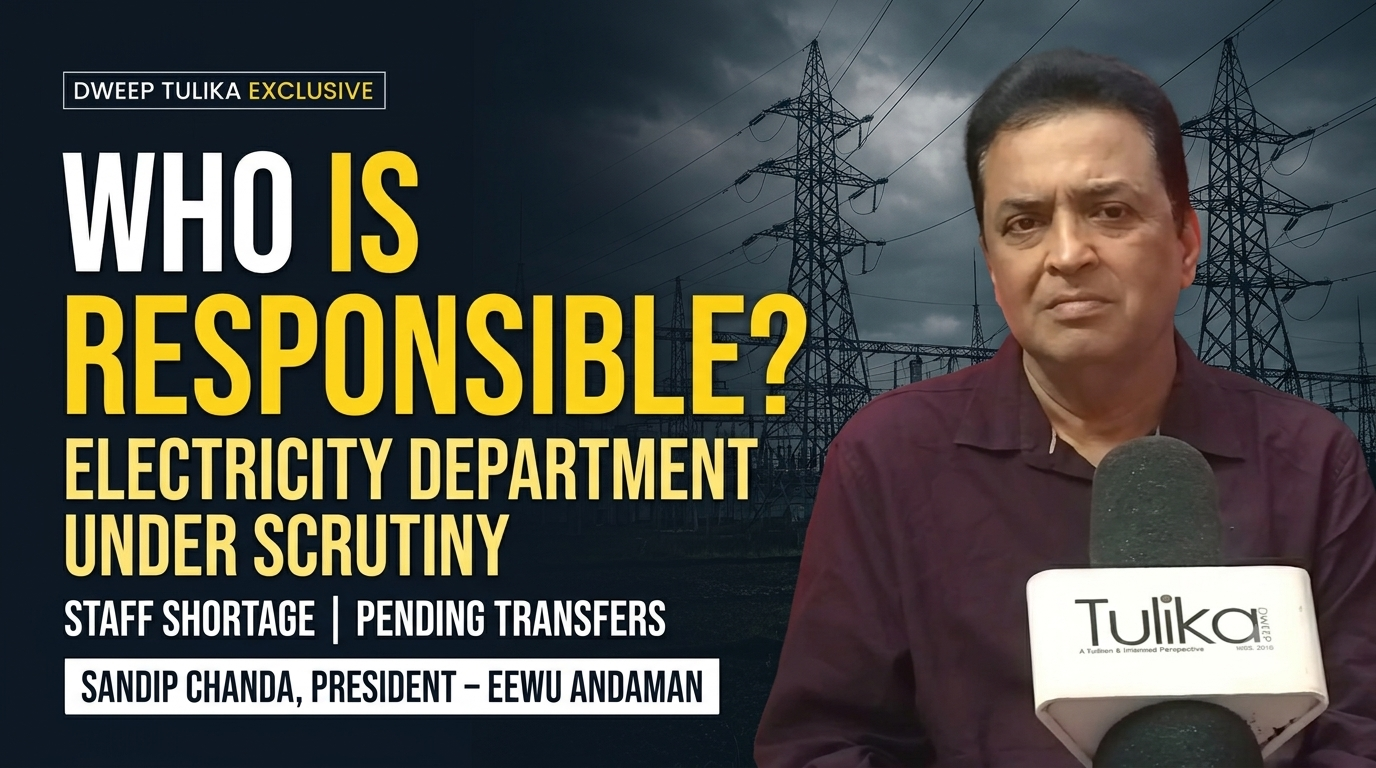
The Electricity Employees Welfare Union (EEWU), Andaman and Nicobar Islands, has raised a series of concerns over staffing shortages, delayed implementation of transfer orders, deployment of engineering personnel and administrative arrangements within the Electricity Department.
In an interview with Dweep Tulika, union president Sandip Chanda alleged that persistent manpower gaps in remote stations, prolonged additional-charge arrangements and the use of technical staff for routine office work were affecting the department's functioning.
The concerns extend from Rangat, Diglipur and Mayabunder in North and Middle Andaman to the Nicobar region, where Chanda questioned why personnel associated with Nicobar postings were still physically stationed at Prothrapur despite being required elsewhere.
The union's account also raises questions about the implementation of Order No. 2157 dated August 13, 2026, which assigned Current Duty Charge (CDC) responsibilities for three Executive Engineer posts.
Union says concerns have persisted since 2023
Chanda said the union's activities gained momentum in 2023 after an officer associated with a rural division retired, leaving the division without a permanent officer. According to him, employees subsequently faced difficulties in matters such as travelling allowance (TA), General Provident Fund (GPF) claims and medical bill settlements.
He said the union took up employee grievances with the authorities through representations and other official channels, including the Centralised Public Grievance Redress and Monitoring System (CPGRAMS). He also referred to representations submitted to ministries and a further representation addressed to the Lieutenant Governor.
The union's concerns, as outlined by Chanda, are not confined to individual service grievances but relate to wider questions of manpower distribution, administrative responsibility and the functioning of field offices.
Engineering staff shortages in remote divisions
One of the principal concerns raised by the union is the alleged shortage of engineering personnel at several power stations and field locations.
Chanda identified Rangat Power House, Diglipur, Mayabunder and Tugapur among the locations facing shortages. He said the shortage of Junior Engineers (JEs) was particularly concerning in areas where field responsibilities had to be managed across multiple locations.
Referring to Nimbudera, he alleged that one Junior Engineer was handling responsibilities for more than one location. The union argued that such arrangements place additional pressure on available technical staff and raise questions about the adequacy of field-level supervision.
Chanda also questioned the continued retention of some Junior Engineers in office-based assignments for extended periods, alleging that certain personnel had remained in the same offices for 10 to 20 years while field stations continued to face shortages.
He raised similar concerns regarding Assistant Engineers, questioning why some were deployed in office assignments while other locations allegedly lacked adequate engineering supervision.
The union maintains that staffing decisions should take into account the operational requirements of field stations, particularly in geographically dispersed areas where power infrastructure requires regular supervision and maintenance.
Nicobar-bound staff allegedly remain at Prothrapur
A significant issue raised during the interview concerns the deployment of staff associated with the Nicobar region.
Chanda referred to arrangements involving Kamorta, Katchal and Chowra and questioned the manner in which electricity personnel were being deployed for these locations. The union's concern is that staff associated with Nicobar postings are still physically stationed at Prothrapur under verbal directions.
This raises important administrative questions: Who authorised the arrangement? Why are the concerned personnel continuing to remain at Prothrapur instead of being stationed at their designated locations? Is there a written order governing the arrangement, and if so, what are its terms and duration?
The issue also brings into focus the availability of personnel for electricity-related operations in remote island locations. In an archipelago where geographical distance can significantly affect maintenance, supervision and response time, clarity in deployment arrangements is essential.
The Electricity Department's position on the Prothrapur arrangement and the status of personnel assigned to Nicobar locations remains to be clarified.
Order No. 2157 and the pending Current Duty Charge issue
The implementation of Order No. 2157 dated August 13, 2026, emerged as another major point of concern.
The order, as referred to in the union's earlier representation and coverage by Dweep Tulika, concerns the assignment of Current Duty Charge responsibilities for three Executive Engineer posts to the following Assistant Engineers:
Shri Sandeep Mukherjee, Assistant Engineer (Degree)
Shri Amarjeet Singh Saini, Assistant Engineer (Degree)
Shri B. Anil Kumar, Assistant Engineer (Diploma)
Chanda alleged that the implementation of the order remained incomplete. He said that while one officer had reportedly moved elsewhere, the posting or relieving arrangements concerning the other two officers had remained pending for months.
He specifically referred to B. Anil Kumar and raised concern over the delay, particularly in view of the officer's approaching retirement.
The union has questioned why an administrative order assigning Current Duty Charge responsibilities has not been followed through with the necessary posting and relieving arrangements. It has sought an enquiry into the delay and accountability for the non-implementation.
The matter also assumes significance in light of the union's earlier claim that the Executive Engineer divisions of Rural, North Andaman Division (NAD) and Nicobar Division (ND) had been functioning without regular Executive Engineers for nearly three years. This claim requires examination against the department's current posting and charge arrangements.
Additional charges and prolonged vacancies
Chanda also questioned the practice of assigning additional responsibilities to officers already holding charge of other locations, including geographically distant areas.
According to him, such arrangements increase the workload of officers and can create practical difficulties in monitoring operations across multiple divisions. He argued that additional-charge arrangements should not become a substitute for regular appointments, particularly in divisions with substantial field responsibilities.
The union's broader concern is that prolonged vacancies at the Executive Engineer level, combined with additional charges and delays in implementing posting orders, may affect administrative supervision and the timely handling of operational issues.
The department's current position on regular appointments and the duration of vacancies in the concerned divisions remains an important question.
Transfer orders and the question of implementation
Transfer and posting arrangements formed another substantial part of the interview.
Chanda alleged that transfer orders involving Junior Engineers, Station Booking Operators (SBOs), linemen, MRC personnel and workers had not been fully implemented. According to him, some employees had not been relieved or moved despite the issuance of transfer orders.
He also questioned the prolonged retention of certain personnel at the same stations, alleging that some Junior Engineers and Assistant Engineers had remained in particular locations for 10 to 20 years.
The union argued that transfer policies should be implemented consistently and transparently, with due consideration to operational requirements and the distribution of available manpower.
Chanda further questioned why transfers appeared to affect some categories of employees while other personnel continued in their existing assignments for extended periods.
The issue, according to the union, is not merely whether transfer orders have been issued, but whether they are being implemented uniformly and within a reasonable period.
Shortages across supporting staff categories
Beyond engineering personnel, Chanda identified shortages in several other categories of employees, including SBOs, linemen, clerical staff, drivers at power houses, meter-related personnel and workers.
He argued that the functioning of electricity offices and field stations depends on an adequate mix of technical and supporting staff. A shortage in one category can increase the workload of employees from other categories and affect the distribution of responsibilities.
The union particularly highlighted the shortage of clerical personnel, alleging that engineers were being required to perform routine office and clerical tasks in addition to their technical responsibilities.
Assistant Engineers allegedly assigned clerical duties
The deployment of Assistant Engineers for routine office work was another issue raised during the interview.
Chanda alleged that engineering personnel were being used for clerical and administrative tasks because of shortages in the clerical workforce. He questioned whether such deployment was consistent with the technical responsibilities for which these officers were appointed.
Earlier Dweep Tulika coverage, based on concerns raised by the union, had identified four Assistant Engineers allegedly assigned clerical or routine office duties at the Superintending Engineer (Technical) Office:
Shri Suresh Kumar
Smt. Usha Kapoor
Smt. Suman Kishen
Smt. Hema Devi
The nature of their official assignments and the administrative basis for their deployment require confirmation from the department.
Chanda also referred to workers assisting clerical staff, including collecting revenue and depositing collections in banks. He said an RTI response had reportedly indicated that workers were assisting clerks and questioned whether such duties were part of their prescribed responsibilities.
The union has raised questions about the relevant duty charts, service responsibilities and written instructions authorising these assignments.
If technical personnel and field workers are routinely required to undertake duties outside their primary responsibilities, the department needs to clarify the administrative basis for such arrangements and whether adequate clerical manpower is available.
Meter-related work and billing concerns
The interview also touched upon meter-related staffing and electricity billing arrangements. Chanda referred to shortages in the personnel required for meter-related work and to the availability of clerical support for maintaining records.
However, the precise extent of the staffing gap and its relationship with billing-related concerns require further documentary clarification. The department's position on meter-reading arrangements, billing records and the deployment of personnel in these functions remains necessary to establish the full picture.
Grievance redressal: Union gives one out of five
When asked to assess the department's grievance redressal mechanism, Chanda gave it a rating of one out of five.
The rating reflects the union president's assessment of how employee grievances are being addressed. His criticism centred on delays, pending representations and the alleged lack of timely action on matters concerning postings, transfers and service-related issues.
The assessment raises a broader question about the effectiveness of existing grievance redressal channels and whether employees receive timely decisions on issues affecting their service conditions and workplace responsibilities.
What the union is seeking
The concerns raised by EEWU point towards a demand for a more transparent and accountable approach to staffing and administrative deployment within the Electricity Department.
The issues highlighted by Chanda include:
Examination of alleged staff shortages at remote power stations and field locations.
Clarification of the deployment of Nicobar-associated personnel who reportedly remain at Prothrapur under verbal directions.
Implementation of Order No. 2157 dated August 13, 2026, and clarification of the pending Current Duty Charge arrangements.
Review of prolonged vacancies in Executive Engineer divisions.
Examination of transfer orders that have allegedly not been implemented.
Review of prolonged postings and the distribution of engineering personnel between offices and field stations.
Clarification of the deployment of Assistant Engineers for clerical and routine office work.
Examination of the duties assigned to workers who reportedly assist with clerical and revenue-related functions.
Strengthening of clerical, technical and supporting staff in locations facing shortages.
A transparent and time-bound approach to employee grievances.
Questions requiring answers from the Electricity Department
The concerns raised by the union warrant a clear response from the Electricity Department and the Andaman and Nicobar Administration.
The department needs to clarify the present staffing position in the affected divisions and power houses, the status of regular Executive Engineer appointments, and the reasons for delays in implementing transfer and Current Duty Charge arrangements.
The Prothrapur issue also requires specific clarification, particularly regarding the authority under which Nicobar-associated personnel are continuing to remain there and whether the arrangement is supported by a written order.
Similarly, the department's position on the deployment of Assistant Engineers for clerical duties, the reported use of workers for revenue collection and banking-related tasks, and the availability of clerical staff should be placed on record.
At the time of publication, the Electricity Department's response to the specific concerns raised by EEWU had not been incorporated into this report. The issues concerning staff deployment, pending transfer arrangements, Current Duty Charge assignments and the use of engineering personnel for clerical work have therefore been presented as allegations and observations made by the union president. Dweep Tulika will seek the department's response and publish any clarification received.
The issues raised by EEWU, if substantiated, point to the need for a closer examination of manpower planning, deployment practices and administrative accountability in a department responsible for an essential public service across widely dispersed islands.