
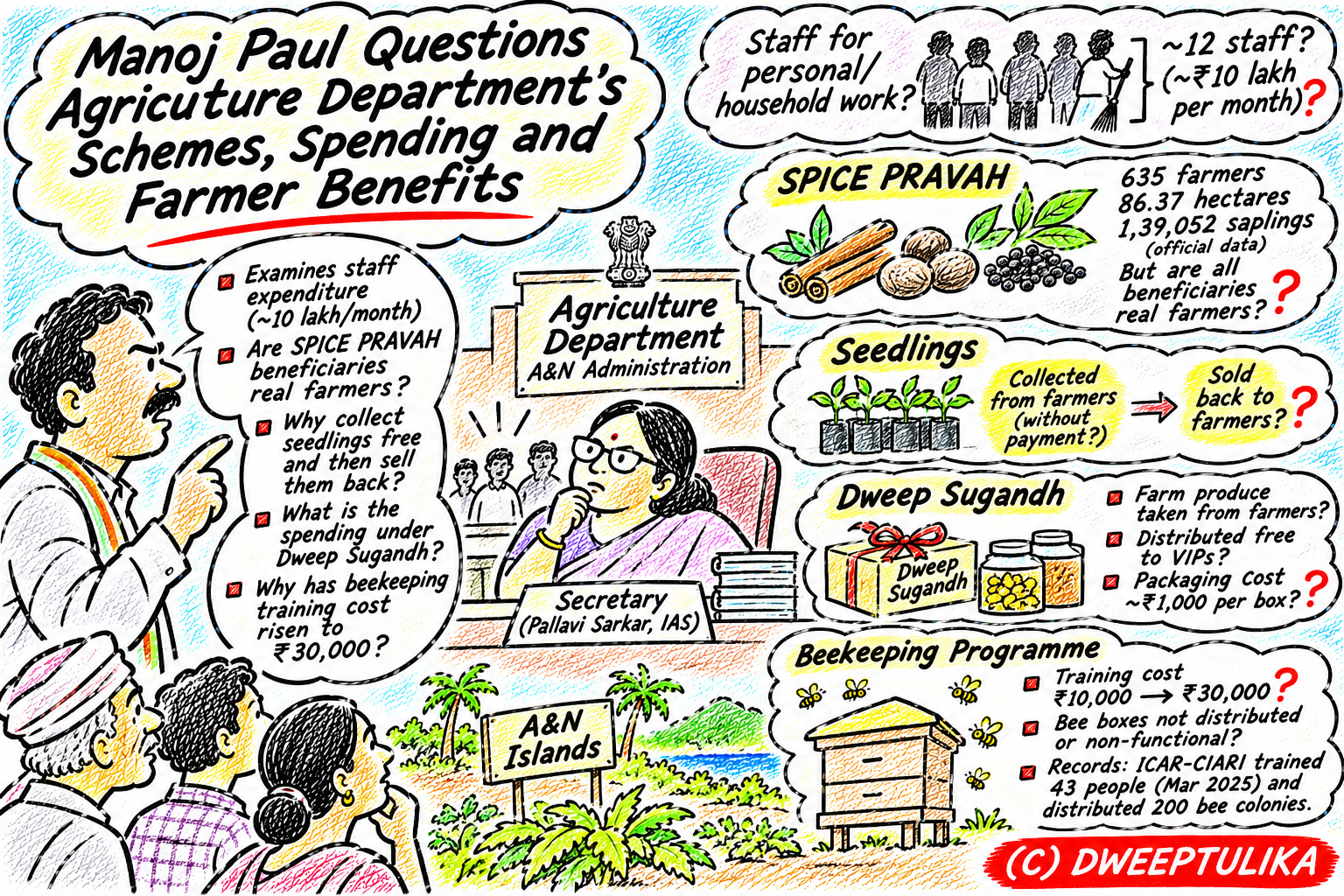
Manoj Paul, Lok Sabha candidate of the Andaman and Nicobar Democratic Congress (ANDC), has raised questions over the functioning of the Andaman and Nicobar Administration’s Agriculture Department, alleging irregularities in the use of public funds, beneficiary selection and the implementation of agricultural initiatives.
In a video statement, Paul named Ms. Pallavi Sarkar, IAS, Secretary of the Agriculture Department, and alleged that certain departmental activities were not adequately benefiting genuine farmers. His allegations covered departmental staffing expenditure, the SPICE PRAVAH initiative, seedling procurement and distribution, the Dweep Sugandh branding programme and beekeeping activities.
The allegations have not been independently established through the material reviewed for this report. Official programme records, however, provide information about some of the initiatives referred to in his statement.
Questions over departmental expenditure
Paul alleged that approximately 12 staff members were engaged for the personal and household requirements of the senior officer and her family. He claimed that the government was spending around ₹10 lakh every month towards their salaries.
He questioned whether public funds were being used appropriately and called for greater accountability from senior administrative officials.
The video statement, however, did not include supporting documents, staff details, salary records or other material establishing the number of personnel or the claimed monthly expenditure. The allegation would require verification through relevant staffing, deployment and expenditure records.
Allegations concerning SPICE PRAVAH beneficiaries
Paul questioned the selection of beneficiaries under SPICE PRAVAH, alleging that a substantial number of those covered by the initiative were not actual farmers.
The programme, run by the Agriculture Department, focuses on promoting spice cultivation, including cinnamon, nutmeg, black pepper, clove and bay leaf.
According to the official SPICE PRAVAH dashboard, as of November 24, 2026, the programme recorded 635 farmers, 86.37 hectares under cultivation and 1,39,052 saplings. The dashboard provides district-wise and crop-wise plantation details and notes that its figures also include plantation details from departmental farms.
These figures indicate the programme’s reported coverage. They do not, by themselves, establish the eligibility of every beneficiary or independently verify the accuracy of every individual entry.
Paul’s allegation concerning the inclusion of non-farmers would require examination of beneficiary lists, eligibility criteria and field-level verification records.
Seedling procurement and distribution questioned
Paul further alleged that the Agriculture Department was collecting seedlings from farmers without payment and subsequently selling planting material back to farmers.
He questioned the arrangement, claiming that farmers were effectively being charged for seedlings that had originally been obtained from them without compensation.
The allegation raises questions about the department’s procurement arrangements, nursery operations, pricing policies and the process through which planting material is supplied to farmers.
The video statement did not provide documentary evidence establishing the alleged procurement and resale arrangement. Relevant purchase records, payment details, nursery stock registers and distribution or sale records would be needed to examine the claim.
Dweep Sugandh branding programme under criticism
Another issue raised by Paul concerned the Agriculture Department’s Dweep Sugandh branding initiative.
He alleged that agricultural produce supplied by farmers, including locally produced spices such as cardamom, was being collected and distributed free of cost to VIPs in the name of product promotion and branding.
He also questioned the expenditure on packaging, alleging that bills of approximately ₹1,000 were being raised for individual gift boxes.
The Administration’s Tourism Department describes Dweep Sugandh as a platform established by the Agriculture Department to promote and market local products, including spices and other value-added goods. Its official description states that the initiative is intended to support fair price realisation for farmers and Self-Help Groups.
An earlier government notice also recorded an assessment exercise to identify farmers and SHGs willing to supply spices for the Dweep Sugandh brand. That notice described the exercise as an assessment of supply availability, with a procurement plan to be formulated subsequently.
These official descriptions establish the stated purpose of the branding initiative. They do not confirm or disprove Paul’s specific allegations concerning free procurement, distribution to VIPs or the cost of individual gift boxes. Those claims would require examination of procurement records, payment details, distribution lists, invoices and expenditure approvals.
Beekeeping programme and training expenditure
Paul also questioned the implementation of the department’s beekeeping-related initiatives.
He claimed that the training cost, which he said was initially around ₹10,000, had increased to approximately ₹30,000 after the concerned officer assumed charge.
He further alleged that the training had not resulted in functional beekeeping units and that bee boxes had either not been distributed or were non-functional where distribution had taken place.
However, institutional records confirm that a beekeeping training programme was conducted at ICAR-Krishi Vigyan Kendra, Sippighat, from March 6 to 10, 2025.
According to ICAR-Central Island Agricultural Research Institute (ICAR-CIARI), the five-day programme benefited 43 participants, comprising 28 men and 15 women. The record also states that 200 bee colonies were distributed among nominated participants during the closing ceremony.
The training was organised in collaboration with the Department of Agriculture, Andaman and Nicobar Administration, and CSIR-National Botanical Research Institute, with funding from CSIR-NBRI under the CSIR-Floriculture Mission (Phase-II).
These records establish that training was conducted and 200 bee colonies were distributed during that programme. They do not establish the present operational status of all distributed colonies, whether recipients continued beekeeping activities, or whether the specific training expenditure cited by Paul is accurate.
Questions requiring official clarification
Paul concluded his statement by criticising what he described as excessive administrative control by officers from the mainland. He argued that elected political leadership should exercise stronger oversight over the bureaucracy and hold senior officials accountable for their decisions and expenditure.
His allegations raise several questions concerning the implementation of agricultural schemes and the benefits reaching farmers across the islands.
The claims concerning departmental staffing and expenditure, beneficiary eligibility, seedling procurement, Dweep Sugandh promotional spending and the operational status of beekeeping units require examination through relevant official records and departmental clarification.
The official records cited in this report confirm certain programme activities and reported coverage, but they do not settle the specific allegations made by Paul.
Dweep Tulika will continue to follow the questions surrounding the implementation of these agricultural initiatives and the benefits reaching farmers across the Andaman and Nicobar Islands.