
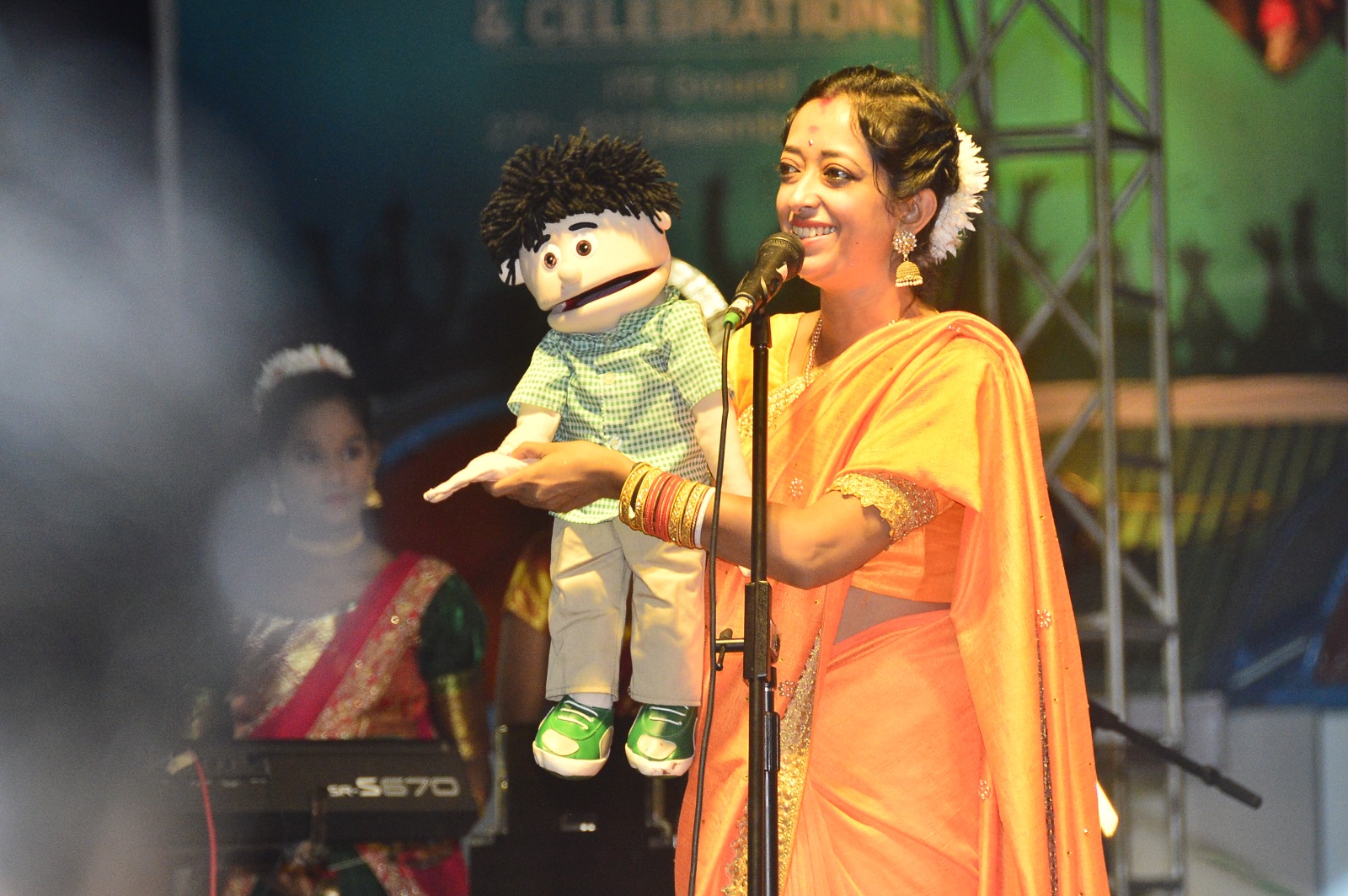
There are artists who dedicate their lives to mastering one art form, and then there are those whose curiosity, passion and commitment take them across several artistic disciplines. Their journeys cannot be confined to a single stage, a single instrument or even a single identity. They become storytellers in different languages of art.
Priyanka Talukdar, widely known by her stage name Softy Sean, belongs to the latter category.
A Hindustani classical vocalist, classical and folk musician, ventriloquist, magician, theatre practitioner, educator, writer, composer, poet, lyricist and trained classical dancer, Priyanka represents an unusually diverse artistic journey emerging from the Andaman and Nicobar Islands.
On her birthday, it is worth looking beyond the familiar greetings and celebrating the years of learning, discipline, experimentation and cultural commitment that have shaped her journey. Her story is not merely about individual achievements. It is also about the possibilities of artistic expression, the importance of cultural education and the responsibility of preserving India's performing arts for future generations.
A journey that began at nine
An artist's journey is often shaped long before the first major recognition arrives. In Priyanka's case, her association with the performing arts began during childhood.
At the age of just nine, in the early 2000s, she represented the Andaman and Nicobar Islands in Bharatanatyam at the National Balashree Competition. At a time when opportunities for young performing artists from the islands to reach national platforms were limited, this became an important milestone in her early journey.
Her participation demonstrated that artistic talent from geographically distant islands could find its place on a national stage.
Classical dance was an important part of her formative years. She received training in Bharatanatyam, Kuchipudi and Mohiniyattam under Shri Kalalayam Manikuttan. These classical traditions demand years of discipline, physical conditioning, rhythmic understanding and expressive ability.
However, an unfortunate back injury eventually interrupted her journey as a classical dancer. For many performers, an injury that restricts physical movement can mean the end of an artistic career. But Priyanka's relationship with art was never limited to dance alone.
Music, theatre, puppetry, writing and other forms of creative expression continued to provide avenues through which she could pursue her artistic interests.
Her journey is a reminder that sometimes an artist may have to change the medium through which they express themselves, but the desire to create does not necessarily disappear.
The musical foundation: A legacy of learning
Music remains one of the strongest pillars of Priyanka's artistic identity.
Trained in Hindustani classical vocal music, she has also explored semi-classical compositions, ghazals and folk traditions. Her musical interests reflect an understanding of India's diverse musical heritage, where classical discipline and folk expression occupy equally important places.
An important influence in her musical development has been her father, Shri Birendra Kishore Talukdar, a senior artist from the Andaman and Nicobar Islands. Her early exposure to music, particularly Hindustani vocal and folk traditions, was shaped by his guidance and the influence of other senior musicians and artists.
This relationship between generations is significant. In traditional Indian music, knowledge has historically travelled through the guru-shishya tradition, with technique, interpretation, musical values and artistic sensibilities developed through sustained learning.
Priyanka's formal education further strengthened this foundation.
She completed Sangeet Bhaskar from Prachin Kala Kendra, Chandigarh, and pursued a Bachelor of Performing Arts in Music from Pondicherry University.
In 2017, she achieved a Gold Medal in BPA Music from Pondicherry University, marking a significant academic milestone.
Her musical training also included guidance from accomplished trainers associated with Rabindra Bharati University, Kolkata, including Biplav Mukherjee and Rajesh Pathak.
Her preference for ghazals and semi-classical music adds another dimension to her musical personality. These genres require not only command over melody but also sensitivity towards poetry, pronunciation, emotion and lyrical interpretation.
For an artist who is also a poet and lyricist, this connection between literature and music becomes particularly meaningful.
Ventriloquism: Giving voices to imagination
Among Priyanka's many artistic pursuits, ventriloquism deserves special attention.
It is an art form that remains relatively unfamiliar to large sections of the Indian audience, particularly when compared with music, dance and conventional theatre. Yet ventriloquism requires a remarkable combination of vocal control, character development, facial expression, timing, humour and storytelling.
The performer must create the impression that a character has an independent voice and personality. It is not simply about speaking without visibly moving the lips. It is about creating a believable relationship between the performer and the puppet.
Priyanka received training in ventriloquism under Shri Prabir Das and Shri Dileep Kumar. She also pursued theatre-related training through the National School of Drama, learning from practitioners including Shri Surinder Sharma, Sandip Bhattacharjee, Shibbu Gaur, Omekar, Abhijit Lahiri, Amit Banerjee and Avinash Deshpande.
Her association with Dhum Ketu Puppet Theatre brought her ventriloquism work further recognition, including recognition from the Sangeet Natak Akademi for her ventriloquism act.
As a woman practising this specialised art, she belongs to a relatively small group of female ventriloquists in India and internationally.
This aspect of her journey deserves particular recognition. Ventriloquism has traditionally had limited visibility in mainstream cultural education and performance opportunities. Women pursuing this specialised discipline are even less visible.
Her work therefore contributes to bringing greater attention to an art form that deserves wider appreciation.
An artist across disciplines
To describe Priyanka only as a vocalist or ventriloquist would leave out much of her artistic identity.
She is also a magician, writer, composer, poet and lyricist. Her creative interests extend across performance, literature and visual imagination.
Her training in theatre has added another dimension to her stage presence. The ability to communicate through different characters, voices and expressions allows her to approach an audience in ways that conventional musical performances may not always permit.
Her experience across Hindustani classical music, folk music, ghazals, semi-classical compositions, puppetry and magic demonstrates an artistic curiosity that crosses conventional boundaries.
This diversity is not merely a collection of hobbies. Each discipline contributes something to the others.
Music develops listening and rhythmic sensitivity. Theatre strengthens expression and characterisation. Ventriloquism develops vocal flexibility and storytelling. Poetry deepens the relationship with language, while composition brings together melody, structure and emotion.
Together, these disciplines form a distinctive artistic vocabulary.
Art beyond entertainment: The educator's perspective
Perhaps one of the most meaningful aspects of Priyanka's journey is the way she has brought her artistic abilities into education.
As a music educator, she has explored ways of making classroom learning more engaging and accessible. One of her distinctive approaches has been integrating ventriloquism into teaching.
Puppets and fictional characters can create a different relationship between a teacher and students. They can encourage participation, reduce hesitation and make complex messages easier to understand.
For children, learning through storytelling and performance can transform an ordinary classroom interaction into an experience that remains memorable.
Priyanka has also used her ventriloquism skills in community awareness programmes. This demonstrates how performing arts can serve purposes beyond entertainment.
A puppet character can communicate an important social message, introduce a difficult subject or encourage people to participate in a discussion.
In this sense, her work reflects a broader understanding of the role of artists in society. Artists need not remain confined to cultural festivals and auditoriums. Their skills can contribute to education, public communication and community engagement.
Mukta Dhara: Preserving culture, nurturing generations
No account of Priyanka's artistic journey would be complete without discussing Mukta Dhara – An Academy of Dance, Drama, Music and Ventriloquism.
Her association with the institution is connected with a larger family commitment towards cultural preservation and artistic education.
Along with her father, family members and other associates, she has been part of efforts to sustain and promote Indian art forms through Mukta Dhara.
The institution has been engaged in providing free training to students in different artistic disciplines and musical instruments for nearly half a century.
This is an important contribution, particularly in an island territory where access to specialised training in traditional Indian performing arts may not always be readily available.
Cultural preservation is often discussed in terms of festivals, celebrations, monuments and performances. But the real continuity of a tradition depends on whether the next generation has an opportunity to learn it.
A classical dance form survives when students learn its movements and expressions. Music survives when younger generations learn its ragas, compositions and traditions. Theatre survives when performers continue to explore its possibilities. Folk traditions survive when their songs, stories and practices are passed on.
Institutions such as Mukta Dhara play a role in this process by creating opportunities for students to learn without making financial circumstances the sole determining factor in accessing artistic education.
The importance of this work becomes even greater in the Andaman and Nicobar Islands, where cultural traditions have evolved through the interaction of communities from different parts of India.
The islands possess a rich and diverse cultural landscape. Sustaining that diversity requires continuous efforts to teach, document, practise and celebrate different art forms.
Mukta Dhara's long association with free cultural training represents an effort in that direction.
Priyanka's contribution to this initiative is therefore part of something larger than an individual artistic career. It is connected to the collective responsibility of ensuring that cultural knowledge does not disappear with the passing of generations.
Representing the islands and reaching wider platforms
Over the years, Priyanka's journey has also included opportunities to participate in programmes and platforms beyond her regular artistic activities.
Her early representation of the islands at the National Balashree Competition remains a particularly important milestone.
Her participation in the Andaman Talent Reality Show, which she reportedly won in 2009, added to her early recognition as a performer.
The introduction presented at a Mukta Dhara cultural programme also referred to her association with an A. R. Rahman-related competition and performances or participation connected with popular television platforms such as Sa Re Ga Ma Pa and Indian Idol.
She was also associated with the G20-related programme held in the Andaman and Nicobar Islands in 2022.
These experiences form part of the wider story of an artist whose interests have taken her through different platforms and forms of cultural engagement.
The significance of an artist like Softy Sean
The story of Softy Sean raises a larger question about how we recognise and support artists from the islands.
Too often, artistic achievements are measured only by mainstream visibility, commercial success or the number of appearances on major platforms.
But the cultural contribution of an artist can be much wider.
It can be found in the student who learns a traditional composition, the child who discovers confidence through a puppet character, the audience that encounters an unfamiliar art form, or the community that receives an important message through a creative performance.
It can also be found in the quiet work of teaching, rehearsing, composing and preserving traditions without expecting immediate recognition.
Priyanka's journey brings together several of these dimensions.
Her formal musical education, her ventriloquism and theatre training, her interest in dance and folk traditions, her creative writing and her work as an educator demonstrate the many ways in which an artist can contribute to society.
Her back injury may have changed the course of her classical dance journey, but her continued involvement in other disciplines reflects the adaptability that artistic life sometimes demands.
There is also an important lesson in her association with Mukta Dhara: preserving culture requires institutions, teachers, families and communities willing to invest time and effort in the next generation.
Individual talent may bring recognition, but sustained cultural work creates a legacy.
A birthday that celebrates more than an individual
Birthdays are often occasions for photographs, greetings and expressions of affection. But they can also offer an opportunity to recognise journeys that deserve wider public appreciation.
As Priyanka Talukdar, known professionally as Softy Sean, marks another year of her life, her journey invites us to look at the performing arts through a wider lens.
She is an artist who has moved between musical traditions, theatre, puppetry, magic, dance and literature. She is an educator who has brought creative performance into the learning process. She is also associated with a family-led cultural initiative that has sought to make artistic training accessible to generations of students.
Her achievements deserve recognition, but so does the commitment behind them.
For the Andaman and Nicobar Islands, artists and cultural educators are important custodians of artistic traditions. Their work helps connect the islands with the wider cultural heritage of India while creating opportunities for younger generations to discover their own creative abilities.
The journey of Softy Sean is a reminder that art is not simply about standing on a stage and receiving applause. It is equally about learning, teaching, experimenting, preserving and passing something meaningful to those who come after us.
On her birthday, Dweep Tulika celebrates Priyanka Talukdar – Softy Sean – not merely for the many roles she has performed, but for the enduring relationship she has built with art, education and cultural preservation.
Happy Birthday, Softy Sean. May your voice continue to carry music, your characters continue to tell stories, and your artistic journey continue to inspire generations.
Dweep Tulika Editorial Team